
Most pre-dents compare dental school tuition by the year. That math hides the real story. When you divide tuition by the actual weeks of instruction, the University of the Pacific Arthur A. Dugoni School of Dentistry charges roughly $25,210 per year, the highest tuition in the ADEA-reported dataset of 67 CODA-accredited U.S. dental programs.
That is not a rounding error. It is a structural feature of how UOP designed its program, and it changes the ROI conversation in ways most applicants never run the numbers on.
The Math Behind $775 Per Week
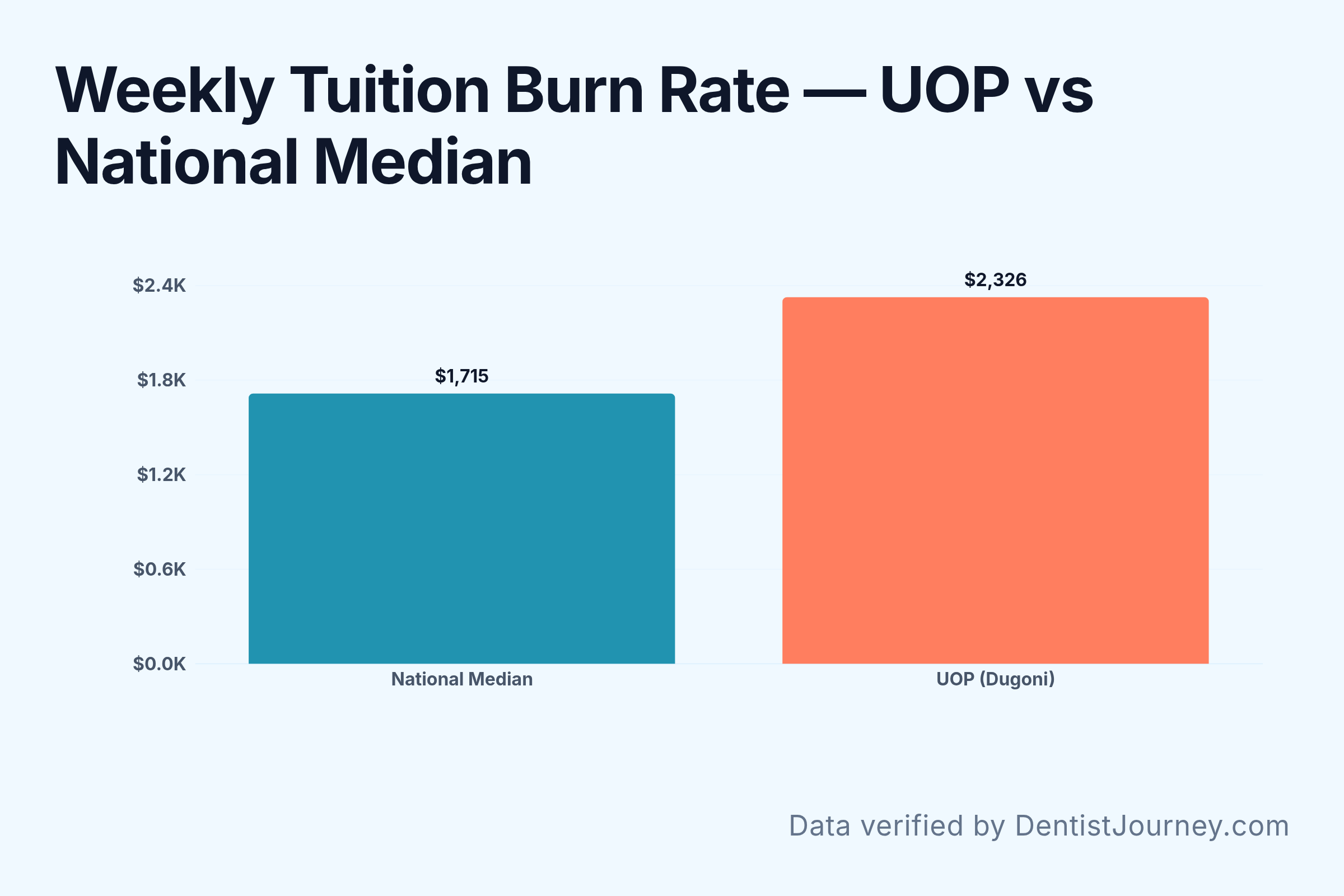
UOP students pay roughly $2,326 per instructional week, calculated by dividing $383,730 in total DDS tuition by 165 instructional weeks across the 3-year accelerated program, which is $775 more per week than the national median program. To fit four years of curriculum into three, the program operates on 11-month academic years rather than the 9-month calendar used at most schools, per UOP's official program catalog. That structure produces about 165 instructional weeks across the full DDS program. A traditional 4-year program runs about 144 instructional weeks, per ADEA's program-length documentation.
UOP's published annual tuition is $127,910, per the school's 2024-2025 cost-of-attendance schedule. That is the highest annual tuition figure in the ADEA-reported dataset and sits well above the outlier threshold of $127,910 calculated from the 67-school distribution.
Divide $127,910 by 55 instructional weeks per year and you get $2,326 per week of annual tuition cost. Spread across the full 3-year program, the total tuition is 3 x $127,910 = $383,730, per UOP's published cost schedule. Divide that by 165 total instructional weeks and the weekly burn rate lands at roughly $2,326 per week of instruction received. By comparison, a school charging the national median annual tuition of $61,748 across a traditional 4-year, 144-week format runs roughly $1,715 per week.
The $775 figure in the headline refers to the gap: UOP students pay an extra $775 per instructional week relative to a median-priced traditional program. That is the burn rate premium.
How Far Above the Mean Is This?
UOP's $127,910 annual tuition is more than three standard deviations (a statistical measure of how far a value sits from the average) above the national mean of $59,843. That makes it a far-tail outlier in the ADEA dataset of 67 dental schools. UOP's $127,910 annual tuition sits more than three standard deviations above that mean[1], which in statistical terms is the textbook definition of a far-tail outlier.
For context: the lowest annual tuition in the canonical dental school database is $32,582 for in-state residents at the most affordable public program. UOP's annual tuition is roughly 3.9 times that figure. Across the full DDS, a student at the median tuition of $61,748 pays $61,748 in total tuition over four years, per the ADEA Official Guide cost calculation. A UOP student pays $383,730 over three years, per UOP's published cost schedule. That is a $136,738 total tuition premium for the UOP degree, before living expenses, fees, or interest on student loans.
The Bay Area Comparison Nobody Runs
UOP costs $204,434 more in total tuition than UCSF for California residents and $155,454 more than UCSF for non-residents, despite both schools sharing the San Francisco metro area. UCSF is the direct geographic competitor and the obvious side-by-side comparison.
UCSF's annual tuition for California residents is $26,434 per the UCSF School of Dentistry 2024-2025 cost-of-attendance page. Across four years, that totals $32,582 in tuition for an in-state student. Compared to UOP's $383,730 across three years, the UCSF resident pays $26,434 less in total tuition for the DDS, per a side-by-side comparison of both schools' published rates.
Even for non-residents, UCSF's annual tuition of $26,434 per the same UCSF cost page produces a four-year total of $105,736. The gap relative to UOP is $155,454 in UCSF's favor, per a non-resident side-by-side comparison.
UOP graduates one year earlier. That is the trade. A UOP graduate enters practice 12 months ahead of a UCSF graduate. Per the U.S. Bureau of Labor Statistics Occupational Outlook Handbook for Dentists, the median annual wage for a general dentist is $170,910. Even if a UOP graduate earned the full BLS median in that extra year of practice, the additional income would not close the in-state tuition gap. For non-residents, one extra year at the BLS median wage would cover roughly $170,910 of the $155,454 gap. That looks close to break-even. However, it ignores debt service (interest payments on loans), taxes, and compounding interest on student loans.
Hypothetical scenario: A California resident chooses between UCSF (four years, in-state) and UOP (three years). They borrow the full tuition cost in federal grad PLUS loans at 8% interest. UCSF student borrows $179,296 over four years. UOP student borrows $383,730 over three years. Even if the UOP student earns one extra year at the BLS median wage of $170,910 and pays down debt fast, interest on the larger UOP loan keeps the UCSF student ahead in net worth for about 15 years after graduation. This assumes a standard 10-year repayment plan.
The Devil's Advocate Section
There are three main counterarguments to the weekly burn rate framing: more clinical hours per week, one fewer year of living expenses ($35,000-$45,000), and earlier entry into the workforce. Together, these offset less than a quarter of the in-state tuition gap with UCSF. The premium remains.
Rebuttal: those factors are real, and they partially offset the headline tuition gap, but they do not eliminate it. The living-expense savings from one fewer year of school in San Francisco run roughly $35,000 to $45,000 based on common cost-of-attendance estimates for the Bay Area in published university budgets. Even at the high end, that offsets less than a quarter of the $204,434 in-state tuition gap to UCSF. The clinical-hours argument is harder to quantify because both UOP and UCSF are CODA-accredited[2], and CODA accreditation requires every U.S. dental school to graduate students who meet the same set of clinical competency standards before licensure. A UOP graduate and a UCSF graduate both have to pass the same INBDE board exam and the same regional clinical licensure exam[3].
Critics might also say UOP is a private school and direct comparisons to a public flagship like UCSF are apples-to-oranges. That is fair as a structural point, but applicants choosing between offers do not get to pick their funding model retroactively. The bill is the bill.
What This Actually Means For Applicants
Applicants should evaluate UOP based on their alternative offers: the $775 weekly premium is defensible if UOP is the only acceptance, questionable if multiple offers exist, and rarely justifiable for California residents with a competitive UCSF application. Acceptance is not guaranteed in any cycle, and a year of lost wages plus another application fee runs real money.
If UOP is one of multiple offers, the math demands you run a side-by-side total-cost-of-attendance calculation, including interest, living expenses, and the value of an extra year of practice. The 3-year clock is a real feature, but it is not free.
If you are a California resident with a competitive application, the UCSF tuition delta is so large that almost no reasonable career-earnings difference closes it.
The right question is not 'is UOP a good school.' UOP is CODA-accredited and produces licensed dentists[3]. The right question is whether the weekly burn rate makes sense for your specific debt tolerance and career plan.
If you are still building your school list, start by stress-testing every offer against the residency-savings math and the full-cost-of-attendance math. The headline annual tuition is the wrong number to compare on. The weekly burn rate is closer to the truth.