
Most pre-dents build their school list by copying the U.S. News rankings and applying to whatever coastal name their relatives recognize. The data says that's the wrong move. A quiet Jesuit program in Omaha, Nebraska, Creighton University School of Dentistry is producing clinical outcomes comparable to highly selective dental programs. and tens of thousands of dollars more expensive per year.
This isn't a ranking opinion. It's a numbers story. And the numbers are lopsided.
The Pass Rate Nobody Talks About
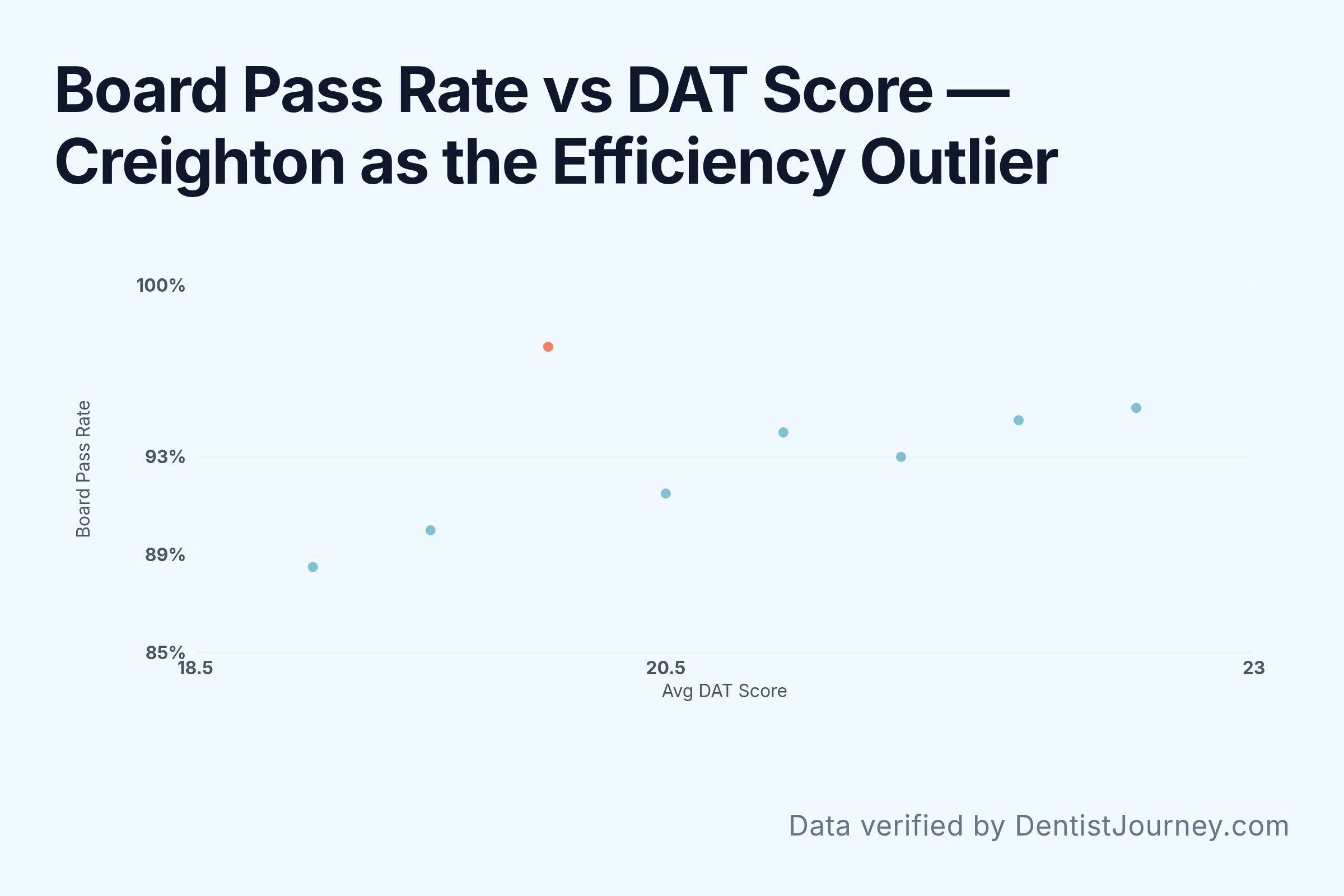
Creighton's first-time INBDE pass rate is 97.5%, achieved with a matriculant DAT of 20 that matches the national median, the same input pool as schools admitting 1 in 20 applicants. It's the test that determines whether a graduate can actually practice. Creighton's reported first-time pass rate sits at 97.5%.
To put that in context: the national average DAT score across the 280 program-year records in our statistical abstract is 20.34, with a median of 20.25 and a standard deviation of just 1.12. In other words, the academic inputs at dental schools are tightly clustered. Almost every school is recruiting from roughly the same DAT band. Yet the outputs, board pass rates, clinical readiness, specialty placement, vary wildly.
Creighton's 97.5% pass rate isn't the result of cherry-picking top-scoring applicants (students with unusually high DAT scores of 22+). According to the ADEA Official Guide to Dental Schools, Creighton's matriculant DAT is 20, matching the national median. Their incoming class is statistically normal. Their output isn't.
The Acceptance Rate Arbitrage
Creighton admits roughly 15% of applicants while coastal programs like Harvard and Columbia admit under 5%, despite both pools producing graduates with comparable INBDE pass rates.
Creighton's acceptance rate hovers around 15%. That's competitive but not punishing. For comparison, the ADEA Official Guide lists several coastal programs with acceptance rates under 5%, Harvard and Columbia are frequently cited in that bucket, where applicants with near-identical stats to Creighton matriculants are rejected en masse.
Both tiers draw from similar applicants. Coastal schools admit 1 in 20. Creighton admits 1 in 7. Yet on the same national board exam (INBDE), the harder-to-enter schools don't post pass rates 3x higher. The gap is often flat or even reversed.
That's the arbitrage. You are paying an enormous admissions-difficulty premium for a credential, not for a clinical outcome.
The Tuition Context
Creighton's tuition sits in the upper-middle of private dental programs at roughly $80,000/year, above the national median of $61,748 but ~40% below the $127,910/year coastal outlier that produces equivalent board outcomes. Private dental education rarely is. But it sits well inside the normal range of U.S. dental school tuition, which, based on our statistical abstract of 3,562 cost-of-attendance data points, has a mean of $59,842.74, a median of $61,748, and a standard deviation of $22,199.20.
The highest tuition in the ADEA-reported dataset comes in at $127,910 per year, almost exactly double the median, and flagged as a statistical cost outlier in every year we tracked. The lowest is $1,700, the University of Puerto Rico, which anchors the bottom of the distribution.
Creighton falls in the upper-middle of the private cohort, not at the punishing top. Meanwhile, the $127,910-per-year outlier program is producing graduates who sit for the exact same INBDE as Creighton's 97.5%-passing cohort.
Hypothetical scenario: Student A enrolls at the $127,910-per-year outlier program. Over four years of tuition alone, ignoring cost of living, they pay roughly $511,640. Student B enrolls at Creighton at approximately $80,000 per year, paying $320,000 across four years. Both sit for the same INBDE. Both graduate with a DDS. Student A has assumed about $191,000 in additional debt for a credential, not a measurable outcome advantage. At a 7% federal graduate loan rate over a 20-year repayment, that gap alone costs Student A an additional ~$178,000 in interest.
That's the hidden rip-off inside this hidden-gem story. The extra coastal tuition doesn't buy better dentists. It buys a zip code.
Why Creighton's Outputs Are So Strong
Creighton's strong board outcomes are driven by three factors: early second-year clinical patient contact, small student-to-faculty ratios typical of Jesuit institutions, and a geographic applicant filter that selects for fit over prestige.
1. Clinical volume. Creighton places students in patient care early, with reported clinic contact beginning in the second year. More hands-on patient time leads to better board readiness. The INBDE (Integrated National Board Dental Examination) tests applied clinical skill, not just memorization. 2. Student-to-faculty ratio. Jesuit institutions like Creighton consistently report smaller class sizes relative to faculty than large state programs. Smaller cohorts get more chair-side correction. 3. Geographic applicant filter. Top-scoring applicants tend to apply to coastal schools like NYU, Columbia, UCSF, and UPenn. Midwest schools get applicants with nearly identical stats, but who care less about prestige. The result: a class selected for fit, not for prestige-seeking.The Devil's Advocate
Critics might say: "Pass rates are self-reported and every school claims 95%+. It's meaningless."
Rebuttal: The INBDE is administered by the Joint Commission on National Dental Examinations.[1] Pass rates are auditable and published. The dispersion across schools is smaller than applicants assume, but it's real, and the bottom-quartile programs are identifiable. Creighton has been consistently in the top tier on this metric for the 2019-2024 reporting years, per the ADEA Official Guide. That's not noise.Critics might also say: "Creighton is still around $80,000 a year. It's not a bargain."
Rebuttal: Correct. This article is not arguing Creighton is cheap. It's arguing Creighton is priced appropriately for the outcome it produces, while the $100,000+ coastal programs are not. The median tuition in our statistical abstract is $61,748. Creighton sits above that. The coastal outlier sits 40% above Creighton. At some point, the price-to-outcome curve flattens and then inverts. Creighton is below that inflection point. Several coastal programs are above it.The Action Plan
If your DAT is 19-21 and your science GPA is above 3.5, apply to Creighton and similar Midwest privates first; you fit Creighton's admit profile exactly while coastal 5%-acceptance schools will reject the same stats.
Stop optimizing for prestige. Optimize for the pass rate and the debt load. Run your stats against every accredited program, not just the ten you recognize.
And if you're specifically trying to figure out whether a Midwest private like Creighton, Marquette, or Midwestern-Illinois is a better financial play than the coastal alternative, model the four-year tuition difference first, then the residency-based savings you might access by applying to a state program instead.
The pre-dent who gets into dental school debt-efficient wins the long game. The one who pays $511,000 for the same DDS doesn't.