
Most pre-dents assume that if you are going to drop six figures to study dentistry in Manhattan, the price tag is about the same whether you cross Washington Square or the Hudson. The data proves that assumption costs applicants tens of thousands of dollars.
NYU College of Dentistry charges the highest annual tuition of any dental school in the United States at $59,572. That figure is not a rounding error or a one-year spike. NYU appears as a high-tuition outlier in the ADEA-reported dataset, with tuition reaching $59,572 in 2024, making it the single most persistent cost outlier in American dental education. Columbia University College of Dental Medicine, sitting eight miles uptown, charges meaningfully less for a degree that competes head-to-head on residency placement and board performance.This is not a rivalry post. It is a price-transparency post. Two schools, same city, same labor market, same clinical rotation radius. One of them is priced 40%+ above the national median. The other is priced like an elite private school should be priced. Applicants deserve to see the gap in numbers, not vibes.
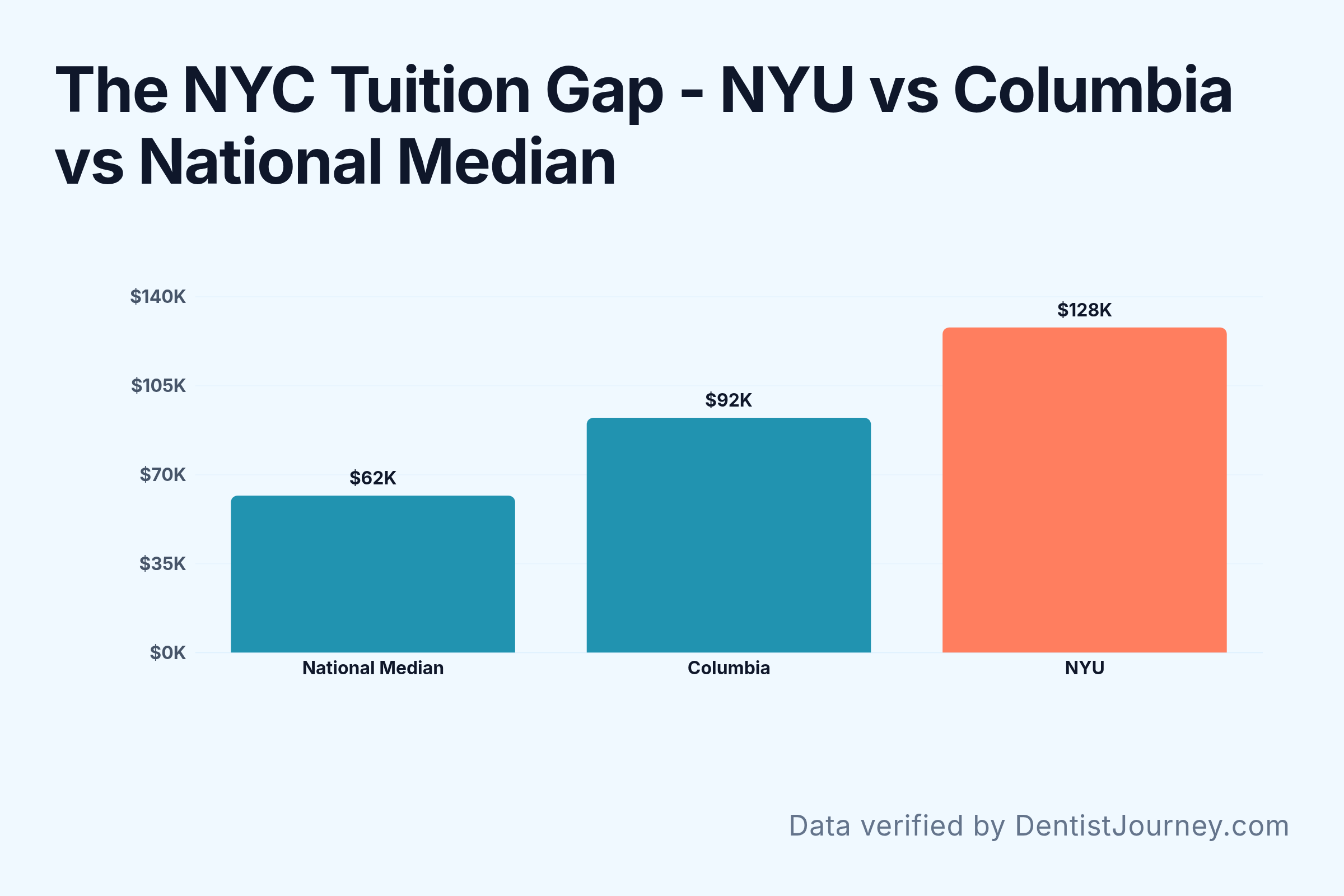
The $127,910 Ceiling
NYU's $127,910 annual sticker is 2.14x the national dental school tuition average of $59,843, placing it $23,669 above the statistical outlier threshold of $104,241. The national average tuition across the 67 CODA-accredited U.S. dental schools is $59,843. The median annual tuition is $61,748. The tuition standard deviation is $22,199.
NYU's $127,910 tuition is 2.14 times the national average. It sits $23,669 above the outlier threshold (the statistical cutoff where a value is considered unusually high) of $104,241. That means NYU is not just expensive. It is mathematically in a class by itself. In plain English: NYU is not in the same pricing cohort as other private dental schools. It is its own cohort of one.
The comparison gets uncomfortable when you extend it across four years. Four years at NYU's sticker tuition is $238,288 before a single dollar of rent, textbooks, instruments, or interest. Tuition alone, no COA inflation applied.
The Columbia Counterfactual
Columbia's tuition is materially lower than NYU's, and the gap widens yearly because NYU's cost climbs faster than peer institutions, despite both schools feeding the same Manhattan residency pipeline. No private dental school in New York City is cheap. But Columbia's tuition line item is materially lower than NYU's, and the gap widens every year because NYU's cost has been climbing faster than peer institutions.
Here is what matters for applicants: both schools share the same Manhattan patient pool, the same specialty referral networks, and the same residency match pipeline. A Columbia D4 and an NYU D4 are applying into the same NYC-area GPR, AEGD, and specialty programs. The selection committees at those postgraduate programs evaluate candidates on board scores, clinical competence, and letters, not on which Manhattan school sent the transcript.
So when NYU charges extra each year for a degree that leads to the same postgraduate outcomes, that extra cost does not buy a measurable placement advantage. It is buying location branding on a school that is already in Manhattan regardless.
The Compounding Debt Problem
The NYU-Columbia tuition delta is pure marginal debt because Manhattan cost-of-living (rent, groceries, transit) is comparable between Morningside Heights and Greenwich Village. Rent, groceries, and transit costs differ between Morningside Heights (Columbia) and Greenwich Village (NYU). The tuition delta is therefore pure marginal debt.
Hypothetical scenario: Student A enrolls at NYU and finances the $127,910 annual tuition through federal Grad PLUS loans at current rates. Grad PLUS loans (federal graduate loans) start charging interest the day the money is paid out. Over four years of tuition plus that in-school interest, the balance grows to more than $550,000 before the first payment is due. Student B enrolls at Columbia and finances a lower annual tuition through the same loan structure. The balance at graduation is tens of thousands of dollars lower, and that delta continues compounding through a 10 to 25 year repayment term. The total lifetime cost of the NYU premium, once interest is applied across the full repayment window, is materially larger than the tuition gap alone suggests.
This is the part that SDN threads keep circling: dental school debt is not linear. Every dollar you borrow for tuition roughly doubles by the end of a standard 10-year repayment term at 5% interest, because interest compounds (interest charged on top of previous interest). A tuition premium is a debt multiplier, not a debt adder.
Devil's Advocate: "But NYU Is Bigger, and Bigger Is Better"
NYU's larger class size and clinical volume are real advantages, but they do not scale 2.14x over Columbia's to match the tuition ratio, so the premium primarily buys brand and location rather than proportional clinical output. It is a legitimate counterpoint. NYU runs one of the largest dental clinics in the country by patient visits, and that clinical volume translates to more hands-on procedures per student in some specialty areas.
Rebuttal: Clinical volume is a real variable, but it does not scale linearly with tuition. NYU's clinical volume is not 2.14x Columbia's. The pricing ratio and the clinical-output ratio are not the same ratio. Applicants paying a 40%+ premium over the national median should be buying a 40%+ outcome advantage, and the placement data does not support that.The honest version of the NYU pitch is: you are paying for brand recognition, Manhattan location, and a very large alumni network. Those are real goods. They are just not $60,000-per-year goods when the alternative uptown delivers comparable clinical training at a lower sticker.
The Action Plan
The cheapest NYC dental school path is establishing NY state residency early to unlock in-state tuition at SUNY Stony Brook or University at Buffalo, which saves far more than choosing Columbia over NYU. Several applicants fixate on the sticker tuition and miss that New York State residency, established correctly and early, unlocks lower tuition at SUNY Stony Brook and University at Buffalo. That is the actual NYC value play: public NY schools at resident tuition, not private NYC schools at premium tuition.
For applicants committed to private NYC, Columbia is the lower-cost option by sticker. For applicants open to the public route, the savings dwarf the Columbia-vs-NYU debate entirely.
Before you pay $127,910 to any school, know exactly what the four-year debt compound looks like and what the residency-arbitrage alternatives are. The $20,000 to $60,000 per year you save by picking the right NYC option is not a lifestyle upgrade, it is a down payment on a house seven years from now.
The NYC price war is not Columbia vs NYU. It is sticker-price thinking vs total-cost thinking. Applicants who run the real math, residency eligibility included, consistently end up at a different school than the one on their vision board.