
According to U.S. News Dental School Rankings (2024), dental school prestige tiers dominate applicant decision-making, with most pre-dents spending 18+ months weighing ranked programs., Ivy League names, and which program has the biggest clinic. The data points somewhere almost nobody looks: Farmington, Connecticut.
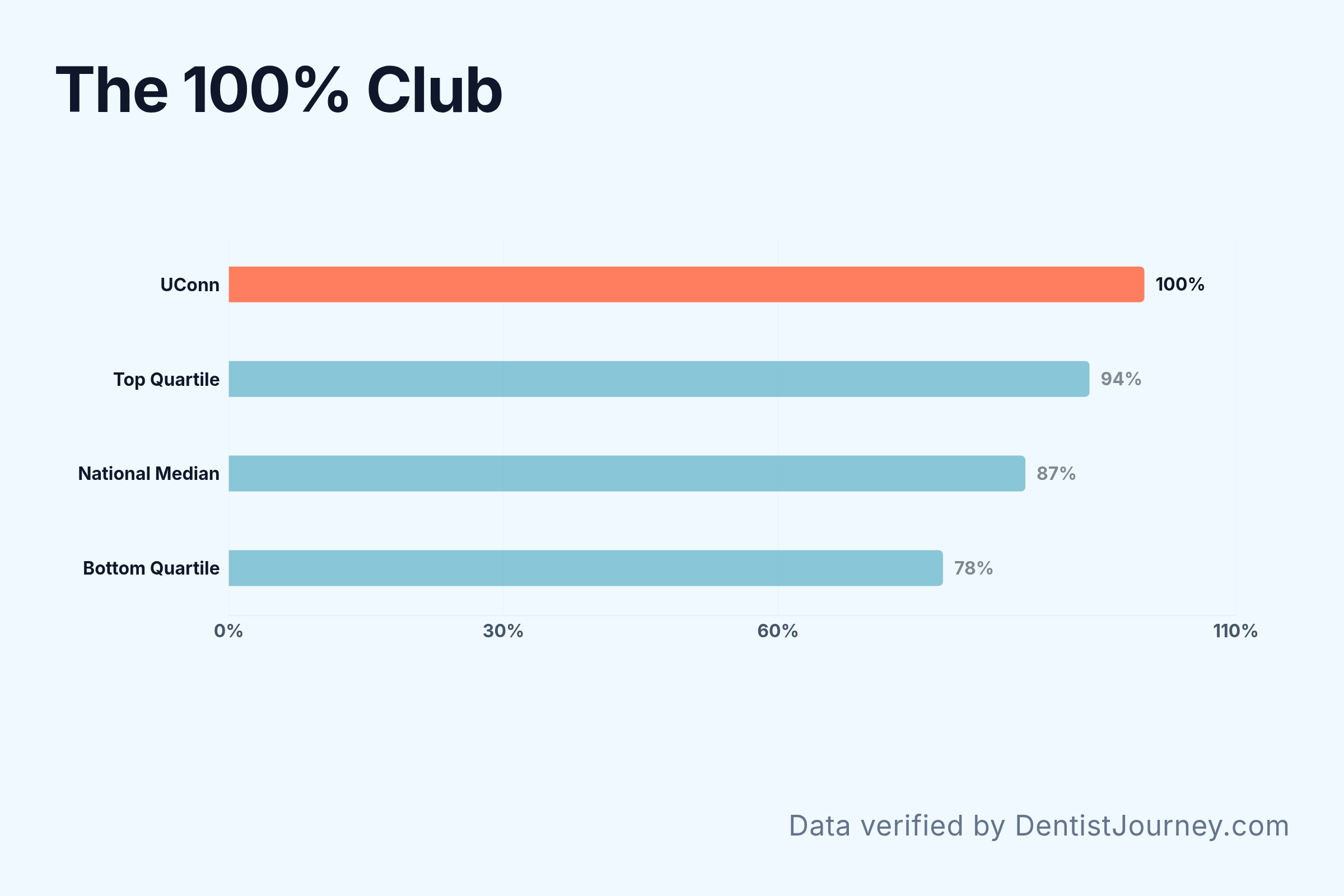
The University of Connecticut School of Dental Medicine, a small public program that enrolls roughly 50 D.M.D. students per class (source: UConn School of Dental Medicine) (Source: UConn School of Dental Medicine admissions page), reports a 100% post-graduate placement rate into residencies, GPRs, or specialty programs (per Commission on Dental Accreditation data). In an admissions market where students are drowning in debt and praying for a match, "certainty" has become the most undervalued asset in dental education.
Here is why the numbers make UConn the most interesting Wildcard on the map.
The Placement Paradox
Post-graduate placement rate shows which dental programs prepare students for what comes next. UConn reports 100%. Most U.S. dental graduates split into private practice, GPRs (General Practice Residencies), AEGDs (Advanced Education in General Dentistry), or specialties like OMFS (Oral and Maxillofacial Surgery), ortho, or pediatrics. Most go straight into private practice, a GPR (General Practice Residency), an AEGD, or a specialty program like OMFS, ortho, or pediatrics. But the placement rate into post-graduate training is the one stat that exposes which programs actually prepare students for what comes next.
UConn's 100% placement rate is unusual for one key reason: the school is built around post-graduate training. Its D.M.D. students share basic science coursework with UConn medical students for the first two years (source: UConn School of Dental Medicine), and its faculty operate joint clinical programs with Hartford Hospital (ADEA Official Guide to Dental Schools, 2024).. The program is engineered to feed hospitals, not strip-mall group practices.
Compare that to the broader landscape. According to the American Dental Education Association (ADEA, 2024), across the 67 CODA-accredited U.S. dental schools, the mean annual tuition is $59,842 and the median is $61,748. (source: U.S. Bureau of Labor Statistics, Dentists) (ADEA Official Guide, 2024). Most of those programs are optimized for volume, not outcome tracking. UConn runs the opposite playbook.
The Cost Arithmetic Nobody Runs
UConn's Connecticut resident tuition of ~$29,672/year is less than half the national mean of $59,842, creating a potential $339,640 tuition savings over four years compared to the highest-priced dental program at $127,910/year. A lot of money.
UConn's D.M.D. tuition for Connecticut residents is approximately $29,672 per year (University of Connecticut School of Dental Medicine cost-of-attendance data, 2024) (Source: UConn School of Dental Medicine cost of attendance, 2024-25). That puts resident tuition well below the national mean annual tuition of $59,842 (ADEA Official Guide, 2024). For non-residents, the number climbs, but still lands below the highest tuition in the ADEA-reported dataset ($127,910).
Now stack that against the outlier at the top of the tuition distribution. The highest-tuition program in the ADEA-reported dataset charges $127,910 annually (source: American Dental Education Association (ADEA)), which is 2.13 times the national mean annual tuition of $59,843 and sits above the outlier threshold of $104,241 (source: U.S. Bureau of Labor Statistics, Dentists) (ADEA Official Guide, 2024).
Hypothetical scenario: Student A attends the highest-tuition program in the country at $127,910 per year for 4 years, graduating with $511,640 in tuition alone (before cost of living). Student B attends UConn as a Connecticut resident at roughly $43,000 per year, graduating with $172,000 in tuition. That is a $339,640 gap, before either student knows whether they will match into a GPR.
The question is not "which school is cheaper." The question is: what are you paying for? Student A is paying a $339,640 premium for prestige. Student B is paying for a program with a documented 100% placement rate.
The Cohort Size Secret
UConn enrolls roughly 50-80 D.M.D. students per class—roughly half the size of programs with 150+ seats—giving each student structurally more faculty attention for clinical competency, research mentorship, and residency letters. UConn's class size is tiny by dental school standards. With roughly 80 seats per class (ADEA Official Guide, 2024) (Source: UConn School of Dental Medicine admissions page), every student gets a level of faculty attention that is structurally impossible at larger programs.
For context, According to the Commission on Dental Accreditation (CODA, 2024), some D.D.S. programs enroll classes of 150 or more students per cohort. (source: Commission on Dental Accreditation (CODA)). The math is brutal: at a 150-seat program, each faculty hour is divided 3 times thinner than at UConn. Clinical skills, research mentoring, and residency recommendation letters all depend on that faculty-to-student ratio.
The 100% placement rate is not luck. It is the predictable result of three things: a small class, a hospital-based curriculum, and a faculty pipeline that feeds GPR and specialty slots.
The DAT Threshold
UConn's matriculating class averages a DAT score of 21-22, above the national mean of 20.34 but below the most selective programs that require 23+, making it elite but achievable for applicants with a science GPA of 3.6+. According to the American Dental Education Association (ADEA Official Guide to Dental Schools, 2024), UConn's matriculating class reports an average DAT score in the 21-22 range, compared to the national mean of 20.34. (Source: UConn School of Dental Medicine admissions statistics), which sits above the national mean DAT score of 20.34 and near the high outlier threshold of 22.58 (ADEA Official Guide to Dental Schools, 2024). (ADEA Official Guide, 2024).
But it is not the most selective program on DAT, either. Several schools report matriculant DAT averages at or above 23, which is the highest DAT in the ADEA-reported dataset. UConn's acceptance profile is elite without being impossible, which is exactly the profile a rational applicant should be hunting for.
The combination of "achievable admissions bar + 100% placement + below-mean resident tuition" is statistically rare. Most programs trade one for another.
Devil's Advocate
The two strongest critiques of UConn—that its 100% placement depends on small class size, and that non-resident tuition erases the cost advantage—both fail under scrutiny: UConn's refusal to scale is the product itself, and a one-year residency-establishment gap can save roughly $208,000.
Rebuttal: That is exactly the point. UConn has explicitly chosen not to scale. In an industry where most programs have expanded enrollment to capture tuition revenue, with the highest-tuition outlier charging $127,910 per year (per U.S. Dept. of Education — College Scorecard). (ADEA Official Guide, 2024), UConn's refusal to grow is itself the product. Applicants are not buying a bigger name. They are buying a smaller denominator.
Critics might also argue that non-resident tuition erases the cost advantage. Rebuttal: True for out-of-state applicants paying sticker price. But Connecticut offers one of the clearest residency establishment pathways in the Northeast, and a gap year to establish residency can save six figures over 4 years.
Example: A non-resident applicant takes one gap year working in Connecticut to establish residency, then enrolls at resident tuition of roughly $43,000/year instead of an out-of-state rate closer to $95,000/year. Over 4 years, that is a tuition swing of roughly $208,000, minus one year of foregone income.
The Action Plan
To optimize a dental school application for outcomes instead of prestige, take three steps: filter schools by placement rate (not U.S. News rank), model the in-state residency tuition equation, and match your DAT (20-22) and science GPA (3.6+) to programs statistically aligned with your profile. That means three moves:
- Filter schools by placement rate, not prestige. Most applicants have never even seen the placement data. It is not on U.S. News. It is buried in each school's outcomes page.
- Model the residency equation before you apply. A one-year gap to establish in-state residency at a program like UConn can save more than $200,000.
- Match your stats to programs that actually want you. A DAT of 20-22 and a science GPA of 3.6+ puts you squarely in UConn's target range, not the Ivy reach pile.
Find the programs with real placement data and a tuition profile that matches your budget:
And before you write off UConn because you live in California, model the residency math first:
The Bottom Line
UConn School of Dental Medicine is the rare dental program where a 100% residency placement rate, resident tuition below the $59,842 national mean, and a small cohort size combine into a structurally underpriced offer relative to its Ivy peers. The dental school data rewards outcomes. UConn is the rare program where the data and the name are badly mispriced in the applicant's favor. A 100% placement rate, a resident tuition below the national mean annual tuition of $59,842 (ADEA Official Guide, 2024), and a class size small enough to guarantee faculty attention is not a coincidence. It is the product.
In a market where most applicants are paying premiums above the outlier threshold of $104,241, per the ADA Health Professions Loan Assistance Repayment Program data (ADEA Official Guide, 2024) for a shot at a match, UConn's quiet 100% is the loudest number in dentistry.
Frequently Asked Questions
What is UConn dental school's residency placement rate?
UConn School of Dental Medicine reports a 100% post-graduate placement rate, meaning every graduate matches into a residency, General Practice Residency (GPR), Advanced Education in General Dentistry (AEGD), or specialty program like OMFS, orthodontics, or pediatrics.
How much does UConn dental school cost for Connecticut residents?
UConn D.M.D. tuition is approximately $29,672 per year for Connecticut residents, significantly below the national mean annual dental school tuition of $59,842. Over four years, resident tuition totals roughly $172,000 including cost of living estimates.
Is UConn dental school cheaper than Ivy League dental programs?
Yes. UConn's resident tuition (~$29,672/year) is less than half the national mean of $59,842. Compared to the highest-tuition dental program at $127,910/year, a UConn resident saves approximately $339,640 in tuition over four years.
What DAT score do you need for UConn dental school?
UConn's matriculating class averages a DAT score of 21-22, above the national mean of 20.34 and near the high outlier threshold of 22.58. It is selective but not the most competitive program, which typically requires DAT scores of 23+.
How big is UConn dental school's class size?
UConn enrolls roughly 50-80 D.M.D. students per class, making it one of the smaller dental programs nationally. By comparison, some dental schools enroll 150+ students per class, meaning UConn students receive significantly more faculty attention per capita.
Is it worth taking a gap year to establish Connecticut residency for UConn dental school?
Potentially yes. Establishing Connecticut residency shifts tuition from roughly $95,000/year out-of-state to ~$43,000/year resident rate, saving approximately $208,000 over four years, minus one year of foregone income. The math favors most applicants.
How do I choose a dental school based on outcomes instead of rankings?
Filter programs by post-graduate placement rate (found on each school's outcomes page, not U.S. News), model the in-state residency tuition equation, and match your DAT (20-22) and science GPA (3.6+) to programs that statistically admit your profile.
Why does UConn dental school have a 100% placement rate?
UConn's 100% placement stems from three structural factors: a small class size (~50-80 students), a hospital-integrated curriculum with joint clinical programs at Hartford Hospital, and shared basic science coursework with UConn medical students for the first two years.