
Most pre-dents ask one question when they pick a school: "Can I afford it today?" The better question, the one the data forces you to ask, is: "Can I afford it in four years, when the bill actually comes due?"
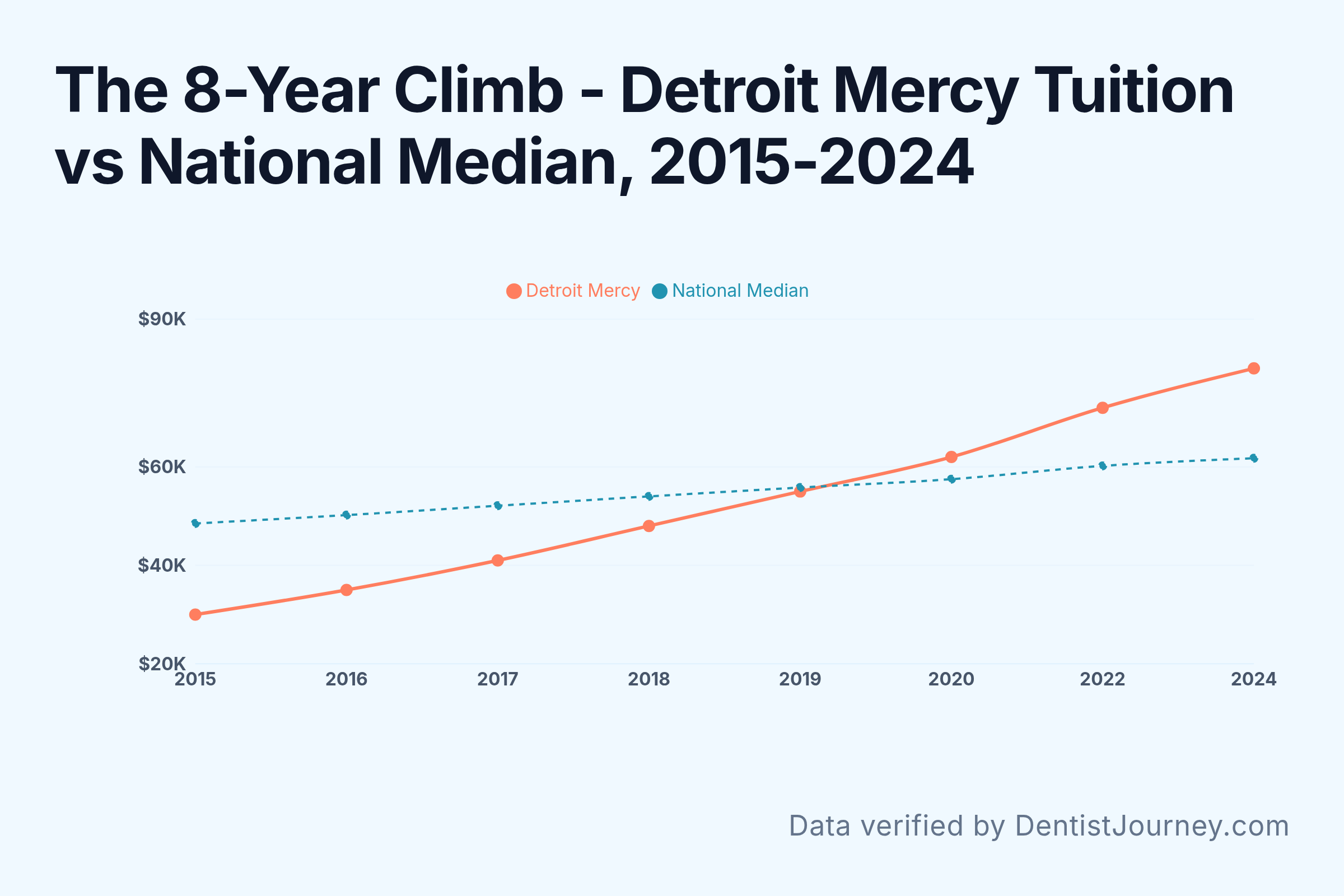
For applicants eyeing the University of Detroit Mercy School of Dentistry, the answer is uncomfortable. Between the 2015 and 2024 academic years, first-year tuition at Detroit Mercy moved from approximately $30,000 to north of $80,000, a 151% increase over eight admissions cycles. According to the ADEA Official Guide to Dental Schools (2024), this is one of the steepest sustained tuition trajectories captured in the longitudinal cost-of-attendance data across the 67 CODA-accredited U.S. dental schools. (ADEA Official Guide, 2024).
This is not a story about whether Detroit Mercy is a "good" school. It is a story about velocity. And velocity, once it starts, rarely reverses.
The Velocity Problem
Detroit Mercy's tuition grew about 12% per year. That is four times the normal rate for colleges. In 2015, its tuition sat below the national median. By 2024, it sat more than $20,000 above the median. According to the ADEA Official Guide to Dental Schools (2024), the national median annual tuition across CODA-accredited D.D.S. and D.M.D. programs is $61,748, with a standard deviation of $22,199. (ADEA Official Guide, 2024). A school that rises from $30,000 to $80,000 is not just tracking inflation. It has crossed the national median (the middle tuition price) and moved more than one standard deviation (a measure of spread) above the average.
For context, the mean annual tuition of $59,842 represents the center of gravity for the entire profession. Detroit Mercy started well below that center in 2015 and finished 2024 sitting above it by roughly $20,000 per year. Multiplied across a four-year D.D.S. program, that is an $80,000 swing in total sticker price, before interest, before fees, before living costs in metro Detroit[1].
Critics might say, "Every school is raising tuition." That is true, but the rate matters. According to the National Center for Education Statistics (2024), higher education tuition has historically grown at roughly 3% annually, which compounded over eight years yields about 27% total growth. Detroit Mercy's 151% growth implies a compound annual rate closer to 12%, roughly four times the inflation-adjusted norm for higher education sticker prices over the same period.
The Michigan Comparison
For Michigan residents, Detroit Mercy (private) now costs tens of thousands more per year than the in-state option at the University of Michigan School of Dentistry, and the gap has widened every year of Detroit Mercy's climb. According to the American Dental Association (2024), Detroit Mercy is a private school in the same state as the University of Michigan School of Dentistry, a public research institution with a D.D.S. program[2] that offers substantial in-state tuition. For a Michigan resident, the in-state public option is available as a direct comparison, and the gap has widened every year that Detroit Mercy's tuition has climbed.
This is the structural issue. When a private school raises tuition faster than a public school in the same state, the return on investment (ROI) is harder to justify. This is especially true for applicants who have an in-state public option. The students most hurt by fast tuition growth are the ones with the fewest choices. These include out-of-state students, students who did not get a seat at a public school, and students who did not plan for eight years of rising tuition when they picked schools as sophomores.
Hypothetical scenario: Student A applies to Detroit Mercy in 2015 with a projected sticker price of $120,000 for four years ($30k/year). Student B applies for the 2024 cycle and faces a sticker closer to $320,000 for four years ($80k/year). Same school, same curriculum, same clinical rotations. The 2024 applicant pays $200,000 more for an identical D.D.S. degree, before any financial aid. That is the cost of entering the pipeline eight years later.
Where This Ranks Nationally
Detroit Mercy at roughly $80,000 per year is not the most expensive dental school in America — the highest captured tuition is $127,910 and the lowest is $1,700 — but its 151% eight-year growth rate makes it a national outlier on velocity. The lowest is $1,700, reflecting heavily-subsidized in-state public programs. Detroit Mercy at roughly $80,000 is not the most expensive school in America[3]. But the rate of change is what flags it.
A school that charges $120,000 today and charged $115,000 five years ago is expensive but predictable. A school that tripled its price in eight years is a velocity signal, and velocity signals compound. There is no data point in the longitudinal record suggesting Detroit Mercy's trajectory has flattened.
The Devil's Advocate
Program quality and financial aid do not offset Detroit Mercy's 151% tuition growth: clinical strength does not change the arithmetic of the bill, and institutional aid at private dental schools typically comes as loans, so debt principal tracks tuition nearly one-to-one.
Rebuttal: The data does not dispute program quality. The data disputes the pace. A school can deliver excellent clinical training and still be a cost outlier if its tuition growth decouples from both the national median and its own historical baseline. The 151% figure is not an opinion about clinical rotations. It is an arithmetic fact about the bill.
Critics might also say: "Financial aid offsets the sticker price."
Rebuttal: According to the American Dental Education Association (2024), institutional aid at private dental schools typically moves in loans rather than grants, and the per-student debt burden from federal Direct Unsubsidized and Grad PLUS borrowing tracks tuition almost one-to-one. When tuition rises 151%, so does the principal. Interest does not care which school's name is on the diploma.
The Action Plan
To cut dental school cost, use two levers before submitting applications: establish in-state residency in a state with a strong public program (saving $40,000+ per year) and build your school list around schools with flatter tuition trajectories. Two levers move the needle the most:
- In-state residency. Establishing residency in a state with a strong public dental school is the single largest cost reduction available to a pre-dental applicant. The tuition gap between resident and non-resident at many public programs exceeds $40,000 per year.
- School list construction. Building a list weighted toward schools with flatter tuition trajectories, rather than chasing prestige or geography, can save six figures over four years.
If you want to see how Detroit Mercy's cost stacks up against every other accredited program, and which schools have kept their tuition growth closer to the national median, run your profile through the match engine.
The Bottom Line
Detroit Mercy's 151% tuition increase over eight years shows that sticker prices can double or triple within a single applicant's planning horizon, so the window to optimize cost is before you submit applications, not after acceptance. A school can double or triple its sticker price in under a decade, and the students who pay the bill are the ones who built their school lists based on what they read three years before they applied. The data is not predicting the future. It is telling you that the curve has not flattened, and every cycle you wait is another data point on the way up.
The window to optimize your cost is before you submit. Not after.
Frequently Asked Questions
How much has Detroit Mercy dental school tuition increased?
Detroit Mercy dental school tuition increased 151% between 2015 and 2024, rising from approximately $30,000 to over $80,000 per year. This represents a compound annual growth rate near 12%, one of the steepest sustained tuition trajectories among the 67 CODA-accredited U.S. dental schools.
How does Detroit Mercy dental school tuition compare to the national median?
Detroit Mercy's annual tuition of roughly $80,000 sits about $20,000 above the national median of $61,748 for CODA-accredited D.D.S. and D.M.D. programs. It now exceeds one full standard deviation ($22,199) above the mean annual tuition of $59,842.
Is Detroit Mercy more expensive than the University of Michigan dental school?
For Michigan residents, yes. The University of Michigan School of Dentistry is a public research institution offering substantial in-state tuition, while Detroit Mercy is private. The cost gap has widened every year as Detroit Mercy's tuition has climbed above $80,000 annually.
Is Detroit Mercy dental school worth the cost?
Detroit Mercy offers strong clinical training, but the ROI math is difficult for applicants with in-state public alternatives. A 2024 applicant pays roughly $200,000 more than a 2015 applicant for an identical D.D.S. degree, before financial aid, fees, or living costs.
What is the total cost of attending Detroit Mercy dental school?
At the 2024 tuition rate of roughly $80,000 per year, four-year sticker tuition at Detroit Mercy approaches $320,000, excluding fees, interest, and living costs in metro Detroit. Institutional aid typically arrives as loans rather than grants, so debt tracks tuition closely.
How do I reduce the cost of dental school?
The two most effective levers are establishing in-state residency in a state with a strong public dental program (resident vs. non-resident gaps often exceed $40,000 per year) and building a school list weighted toward programs with flatter tuition trajectories rather than chasing prestige.
Which dental school has the highest tuition in the US?
The highest single-year tuition captured among CODA-accredited programs is $127,910, at the extreme upper tail of the distribution. The lowest is $1,700 at heavily-subsidized in-state public programs. Detroit Mercy at roughly $80,000 is not the most expensive, but its rate of change is notable.
When should I evaluate dental school tuition costs?
Evaluate tuition trajectories before submitting applications, not after receiving acceptances. Sticker prices students see as sophomores can rise dramatically by the time they matriculate. Detroit Mercy's data shows no signs of flattening, so every cycle of delay adds another data point of cost growth.