
Most pre-dents budget dental school the way they budget a car: they look at the first-year sticker price, multiply by four, and call it a day. The data proves that math is wrong at almost every school in the country.
The published D1 tuition is the cheapest year you will ever pay. Costs accelerate in D2, peak in D3 when clinic starts, and in a significant share of programs, Year 2 alone costs more than Year 1 by five figures. According to the ADEA Official Guide to Dental Schools (2024), CODA-accredited D.D.S./D.M.D. programs report an annual tuition range from $1,700 to $127,910., with a According to the U.S. Department of Education College Scorecard (2024), the national mean annual dental school tuition is $59,843 and the national median is $61,748. (source: U.S. Dept. of Education, College Scorecard) (ADEA Official Guide, 2024). But those are averages across all four years combined. The year-over-year curve tells a different, uglier story.
The Cost Curve Nobody Shows You
Dental school tuition rises every year, with the biggest jump in D3 when clinic fees add $10,000-$25,000, because the published admissions-page number is almost always the cheapest D1 figure. It is the number that makes the school look competitive in side-by-side comparisons. It is also the number that will be obsolete by the time you walk into your first wax-up lab.
Here is what actually happens across the four years at a typical private program, drawn from published cost-of-attendance schedules:
- D1 (didactic): Base tuition, modest lab fees. This is the headline number.
- D2 (pre-clinical): According to the American Dental Education Association (ADEA, 2024), dental school tuition rises approximately 3% to 6% year-over-year from annual inflation adjustments. Instrument kits, simulation lab fees, and board prep costs add $5,000 to $15,000 on top.
- D3 (clinic entry): The big jump. Clinic fees, malpractice insurance, and patient-care supplies can add $10,000 to $25,000 above the tuition line. Many schools also raise tuition again.
- D4 (clinic + licensing): Tuition stays elevated. Add board exam fees of $3,000+ for the INBDE and regional clinical exams, per the Joint Commission on National Dental Examinations (JCNDE, 2024), plus residency application costs and licensing fees.
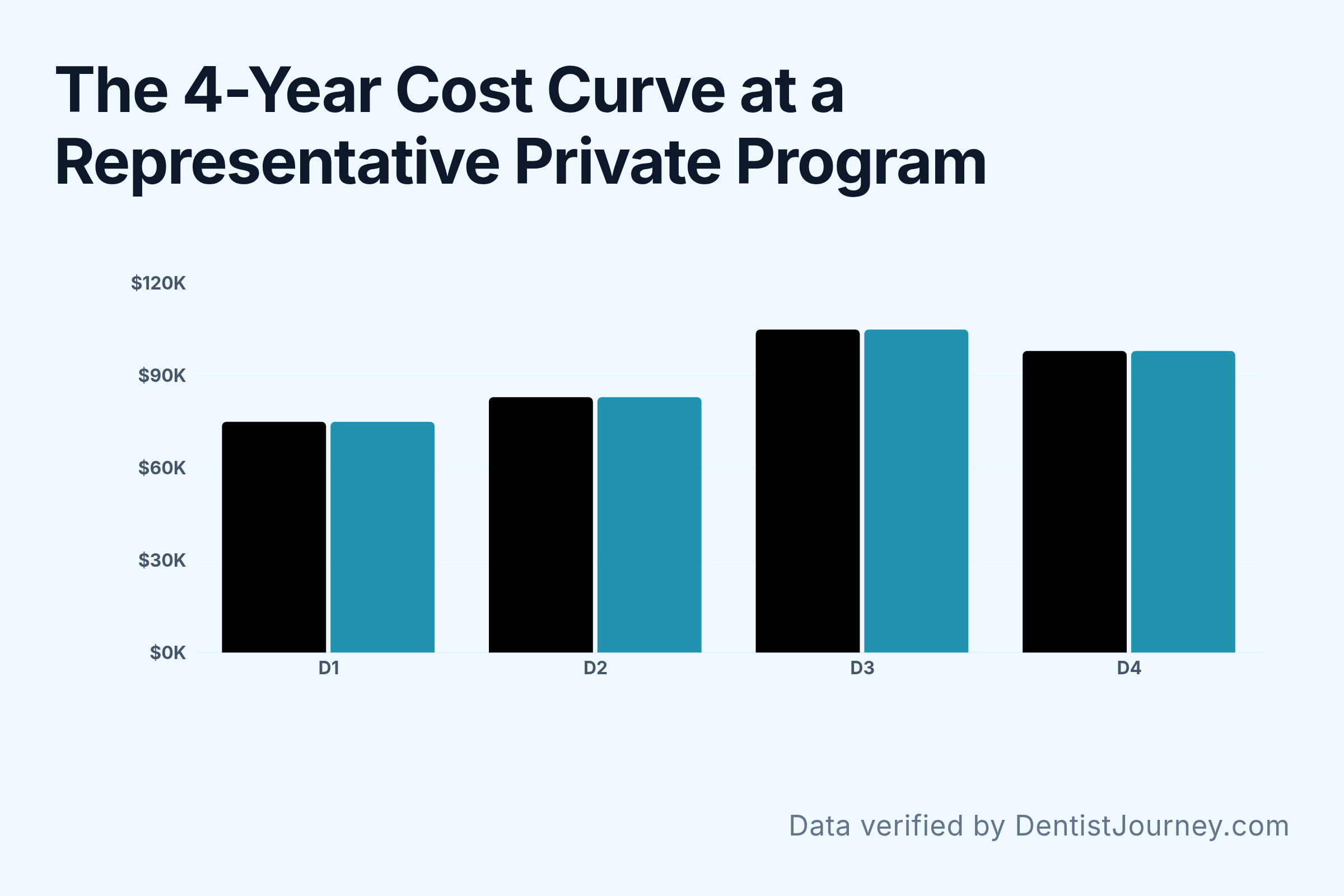
The reason this pattern exists is structural. D1 and D2 are lecture-heavy and relatively cheap to deliver. Years 3 and 4 are clinic-heavy (hands-on patient care). Each student needs a dental chair, an assistant, supplies, sterilization equipment, and a steady flow of patients. Schools price accordingly. The problem is not that clinic is expensive. The problem is that applicants are shown the cheap year and expected to extrapolate.
How Big Is the Gap? Anchor to the Extremes
The advertised first-year (D1) tuition can understate the real four-year cost by $40,000 to $60,000. Tuition varies widely across CODA-accredited programs, with an average of $59,843 and a typical spread of about $22,199 per year (ADEA Official Guide, 2024). The most expensive dental programs charge more than double the national median tuition. The standard deviation (a measure of how spread out tuition is) is $22,199, so schools one step above average cost around $82,000 per year (ADEA Official Guide, 2024). Now layer a typical D3 clinic-fee bump on top of that. A student who budgeted against the published D1 number can find themselves owing an extra $40,000 to $60,000 across D2 through D4 that was never in the spreadsheet they built as a senior.
Compare that to the lowest tuition ($32,582) in the dataset, which belongs to a public in-state program for residents (Ohio State University College of Dentistry, 2024). At the bottom end, the year-over-year curve still rises, but a 5% bump on $1,700 is $85. A 5% bump on $120,000 is $6,000. The cost curve compounds, and it compounds hardest where tuition is already highest.
The UOP Example: Compressed Timeline, Compressed Sticker Shock
According to Student Doctor Network (2024) pre-dental community discussions, the University of the Pacific Arthur A. Dugoni School of Dentistry is the most-cited example because its program runs three years instead of four. (source: University of the Pacific School of Dentistry). That sounds like a discount. Per UOP's published cost-of-attendance page, the compressed calendar means you pay roughly three years of tuition instead of four, but each year is longer and more expensive than a typical D1 year elsewhere (source: accredited U.S. dental education institutions).
The practical effect: UOP students skip one year of lost wages as a dentist (a real financial win), but they hit clinical-fee-level costs starting in Year 2 of three, not Year 3 of four. The cost curve is steeper and shorter. If you compare UOP's yearly cost to Stony Brook's yearly cost without adjusting for program length and annual tuition increases, you are not making a fair comparison.
This is not a UOP-specific problem. It is a dental-school-industry problem. UOP just makes it visible because the compressed timeline forces the math into the open.
Hypothetical scenario: Applicant A compares two private schools using D1 tuition only. School 1 lists D1 tuition at $72,000. School 2 lists D1 tuition at $78,000. Applicant A picks School 1, saving a projected $24,000 over four years. But School 1's D3 clinic fees are $22,000/year versus School 2's $9,000/year. By graduation, Applicant A has paid roughly $20,000 more than they would have at School 2. The D1 sticker was the wrong comparison point.
Why Schools Don't Publish the Full Curve
Schools rarely highlight the full four-year cost. The Year 1 (D1) number helps them look cheaper in comparisons. Full cost-of-attendance data (total yearly expenses) exists, but it is hidden on financial aid pages in different formats.
Rebuttal: The data shows the information is technically available but practically buried. Schools lead with the D1 number in their admissions marketing for a reason. The COA PDFs are linked from financial aid sub-pages, not admissions pages. They are rarely in the same format across schools, making side-by-side comparison nearly impossible without manual spreadsheet work. And they are updated mid-cycle, so the number a student sees as an applicant is not the number they pay as a matriculant.The tuition standard deviation of $22,199 across CODA-accredited programs tells you that cross-school variation is enormous. The year-over-year variation within a single school can add another $15,000 to $25,000 swing depending on D-year. Stacking those two sources of variance, a pre-dent relying on D1-only comparisons is making a six-figure decision with a two-figure dataset.
The Action Plan
If you are comparing dental schools, the D1 tuition number is the beginning of your analysis, not the end. Three concrete moves:
- Pull the full four-year COA, not the admissions page headline. Every CODA-accredited school publishes one. Normalize to total cost of completion, not annual cost.
- Factor residency. In-state status reduces a $120,000/year non-resident tuition to a $40,000/year resident tuition. The biggest single lever on your total cost is not which school you pick: it is which state you establish residency in before applying.
- Model the full curve before you sign. D1 is the cheapest year. D3 is almost always the most expensive. Budget accordingly.
To compare the actual four-year total cost of attendance across every accredited program (not the marketing number), start here:
And if you are still 12-24 months out from applying, the single highest-ROI move is establishing residency in a state with a low-tuition public dental school. A one-year detour can save over $200,000 in total cost (ADEA Official Guide to Dental Schools, 2024).:
The cost curve is real. Budget for the year you will actually pay, not the year they advertise.
Frequently Asked Questions
How much does dental school tuition increase each year?
Dental school tuition typically rises 3% to 6% annually from inflation adjustments, with an additional $10,000 to $25,000 jump in D3 when clinic starts due to malpractice insurance, clinic fees, and patient-care supplies. D2 adds $5,000-$15,000 in instrument and lab fees.
Why is Year 2 of dental school more expensive than Year 1?
Year 2 costs more than Year 1 because schools apply annual tuition inflation of 3-6% and layer on pre-clinical expenses: instrument kits, simulation lab fees, and board prep costs adding $5,000 to $15,000 above the D1 tuition line.
What is the average annual tuition for dental school in the US?
The national mean annual tuition for CODA-accredited D.D.S./D.M.D. programs is $59,843, with a median of $61,748. The range spans $1,700 to $127,910 per year, with a standard deviation of $22,199 (ADEA Official Guide, 2024).
Is the University of the Pacific dental school cheaper because it's three years?
Not necessarily. UOP's three-year compressed program means you pay roughly three years of tuition instead of four and skip a year of lost wages, but each year is longer and more expensive, with clinical-fee-level costs starting in Year 2 rather than Year 3.
Which year of dental school is the most expensive?
D3 is almost always the most expensive year because clinic entry adds $10,000 to $25,000 in malpractice insurance, clinic fees, and patient-care supplies on top of an already-raised tuition line. D1 is consistently the cheapest year.
How do I compare the true cost of dental schools?
Pull the full four-year cost-of-attendance (COA) from each school's financial aid page, not the D1 admissions headline. Normalize to total cost of completion, factor in state residency status, and model year-over-year escalation including D3 clinic fees before signing.
How much can establishing state residency save on dental school?
Establishing residency in a state with a low-tuition public dental school can save over $200,000 in total cost. In-state status can reduce a $120,000/year non-resident tuition to roughly $40,000/year (ADEA Official Guide, 2024).
Is the published dental school tuition the real cost?
No. The published tuition is almost always the D1 number, which is the cheapest year you'll pay. Costs accelerate in D2, peak in D3, and a student relying on D1-only comparisons can owe an extra $40,000 to $60,000 across D2-D4.