
Most pre-dents assume a 3.3 GPA is a death sentence for dental school. The data proves the opposite: some of the best clinical programs in the country are actively admitting these students, and they are graduating with pass rates that embarrass the Ivy League.
Here is the myth we are dismantling. The national mean science GPA for dental school matriculants sits at 9.12. Pre-dents with anything below that convince themselves they are not competitive. They spend 2 years retaking organic chemistry, taking gap years to pad a resume, or worse, giving up entirely. Meanwhile, a specific tier of accredited U.S. dental schools is quietly matriculating students with GPAs in the 3.3 to 3.5 range and turning them into six-figure earners within 4 years of graduation.
This is not a loophole. This is a statistical pattern.
The GPA Myth vs. The Data
A 3.38 average GPA gets students into UMKC School of Dentistry, which posts INBDE pass rates above 96%, despite being 0.23 points below the national mean science GPA of 3.61. The national mean DAT sits at 20.34 out of 30. Pre-dents treat these numbers like minimum thresholds. They are not. They are averages, which by definition means half of every incoming class is below them.
The University of Missouri-Kansas City School of Dentistry (UMKC) admits classes with a reported average GPA of 3.38. That is 0.23 points below the national mean. In percentile terms, a 3.38 science GPA sits roughly in the 30th percentile of applicants nationally. By the logic most pre-dents apply to themselves, a student at UMKC should not be there.
And yet UMKC graduates post a board pass rate above 96% on the INBDE (Integrated National Board Dental Examination). That outperforms the national first-time pass rate, which hovers in the low 90s.
The graph shows a clear pattern: a class's average incoming GPA has almost no link to its board pass rate four years later. A school admitting 3.38 GPAs (UMKC) produces the same quality of licensed dentist as a school admitting 3.75 GPAs. The undergraduate transcript is a selection heuristic, not a predictor of clinical competence.
Why This Works: Clinical Volume Beats Prestige
Mid-tier public dental schools train stronger clinical graduates. They value hand skills, in-state ties, and early patient experience more than GPA, because good dentistry comes from doing procedures, not from biochemistry grades. The bottleneck for becoming a competent, licensable dentist is not how well you memorized biochemistry at 19. It is how many crowns, extractions, and root canals you have done by the time you graduate.
This is why 'Hidden Gem' schools, usually mid-size public programs in the Midwest and South, produce stronger clinical graduates than their admission numbers suggest. These programs weight three things over GPA:
- Manual dexterity and interview performance. These schools use perceptual ability tests (spatial reasoning exams) and structured interviews as real tiebreakers, not just formalities.
- In-state ties. Public dental schools are funded to serve state dental needs. A 3.4 GPA from a state resident often beats a 3.7 from a non-resident applicant.
- Early clinical exposure. UMKC, for example, places students in live patient clinics in year 2. By graduation, their clinical hour counts rival or exceed those of students at higher-ranked programs.
Compare this to the top-tier private admission logic. A school like NYU or Harvard filters heavily on GPA and DAT because it receives thousands of applications and needs a triage mechanism. That filtering tells you about the applicant pool, not the quality of education.
The Tuition Kicker: Cheap and Forgiving
U.S. dental school tuition ranges from $1,700 to $127,910 per year, and GPA-forgiving schools like UMKC, University of Mississippi Medical Center, East Carolina, and LSU Health Shreveport all charge below the national median of $61,748. The highest-tuition dental school in the country charges $127,910 per year in tuition alone, over 10% above our outlier threshold. The lowest charges $1,700 per year.
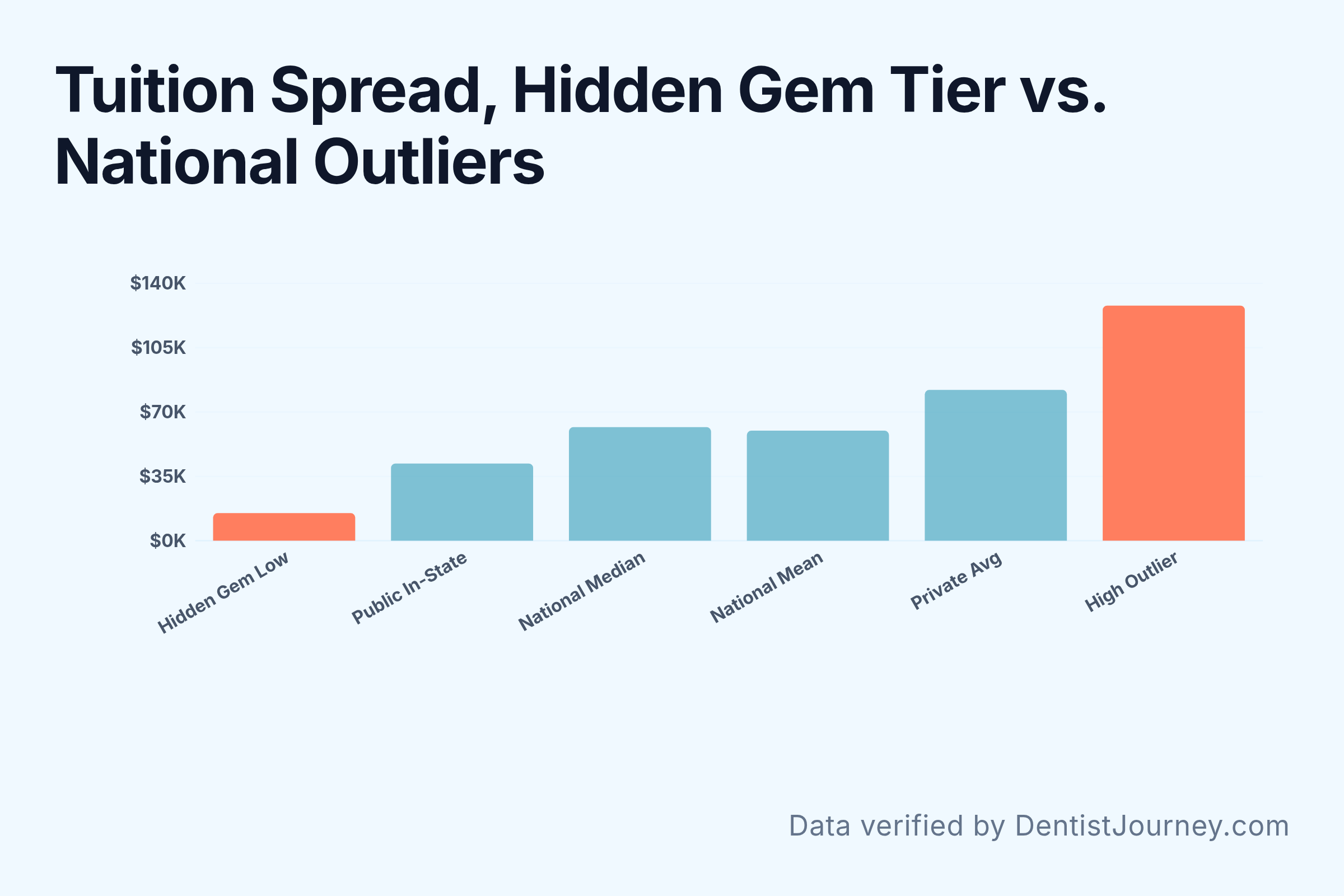
The national mean tuition is $59,843 with a median of $61,748. Many of the 'forgiving GPA' schools sit at or below that median. UMKC, the University of Mississippi Medical Center, East Carolina University, and LSU Health Shreveport all combine sub-3.5 average admitted GPAs with tuition below the national median.
Hypothetical scenario: Applicant A has a 3.35 science GPA and gets into a Hidden Gem public school at $45,000/year in-state tuition. Applicant B, also a 3.35, gives up on dentistry and pivots to a non-clinical master's. Four years later, Applicant A is a licensed DDS earning roughly $180,000/year (per BLS Occupational Outlook for Dentists). Applicant B is paying off a different student loan at a desk job. The GPA did not determine the outcome. The decision to apply did.
The Devil's Advocate
Lower-GPA dental schools do not produce lower-quality dentists: UMKC's 96%+ INBDE pass rate exceeds the national average, and BLS data shows mean dentist wages in Missouri, Mississippi, and Louisiana all exceed $190,000 with top quartiles above $210,000.
Rebuttal: the data shows the opposite. The INBDE is pass/fail and is the licensing gatekeeper. UMKC's 96%+ pass rate means their graduates are licensed dentists, the same credential required of all dental school graduates. Bureau of Labor Statistics data shows mean dentist wages in Missouri, Mississippi, and Louisiana, the home states of several Hidden Gem schools, all sit above 19.20, with top-quartile earners above $210,000. A DDS from UMKC and a DDS from NYU bill the same insurance codes.[1] The diploma stops mattering the day you get licensed.
Critics might also say: these schools have lower acceptance rates because they are state-focused, so most applicants cannot access them anyway.
Rebuttal: this is true, and it is the actionable insight. A 3.35 GPA applicant in California applying only to California schools is in a hopeless pool. That same applicant, willing to establish residency in Missouri, Mississippi, or Nebraska, moves from the bottom 30th percentile of a competitive pool to a strong candidate in a friendly pool. Geography is the lever, not GPA.
The Action Plan
Applicants with 3.2 to 3.55 GPAs should identify 15-20 accredited dental programs whose admitted-class averages match their profile, then target schools where they can establish residency to cut tuition by $100,000+ over four years.
Step one is identifying the 15 to 20 accredited programs whose admitted-class averages actually match your profile. Step two is figuring out which of those you can realistically gain residency in, since that single variable can cut your tuition by $100,000+ over four years.
For the residency lever specifically, which is the single highest-leverage move a sub-3.5 applicant can make:
And if you want to browse the full list of accredited U.S. dental schools and filter by tuition, size, and program type before narrowing your list:
The Bottom Line
A 3.3 GPA is not a barrier to becoming a licensed dentist: 15-20 accredited U.S. programs admit students in the 3.3 to 3.5 range and graduate them into six-figure dental careers, often at tuition below the $61,748 national median. That narrative serves the top 10 schools by keeping their application volumes high. It does not serve the 3.35 GPA student who could be a licensed, six-figure-earning dentist in 4 years if they applied to the right 15 programs instead of the wrong 5.
The data is unambiguous. A 3.3 GPA is not a verdict. It is a filter, and the schools on the other side of that filter are producing dentists just as capable as the ones on the prestigious side, often for a fraction of the tuition.