
Most pre-dents assume that more patient contact equals a better dentist. The data tells a more complicated story.
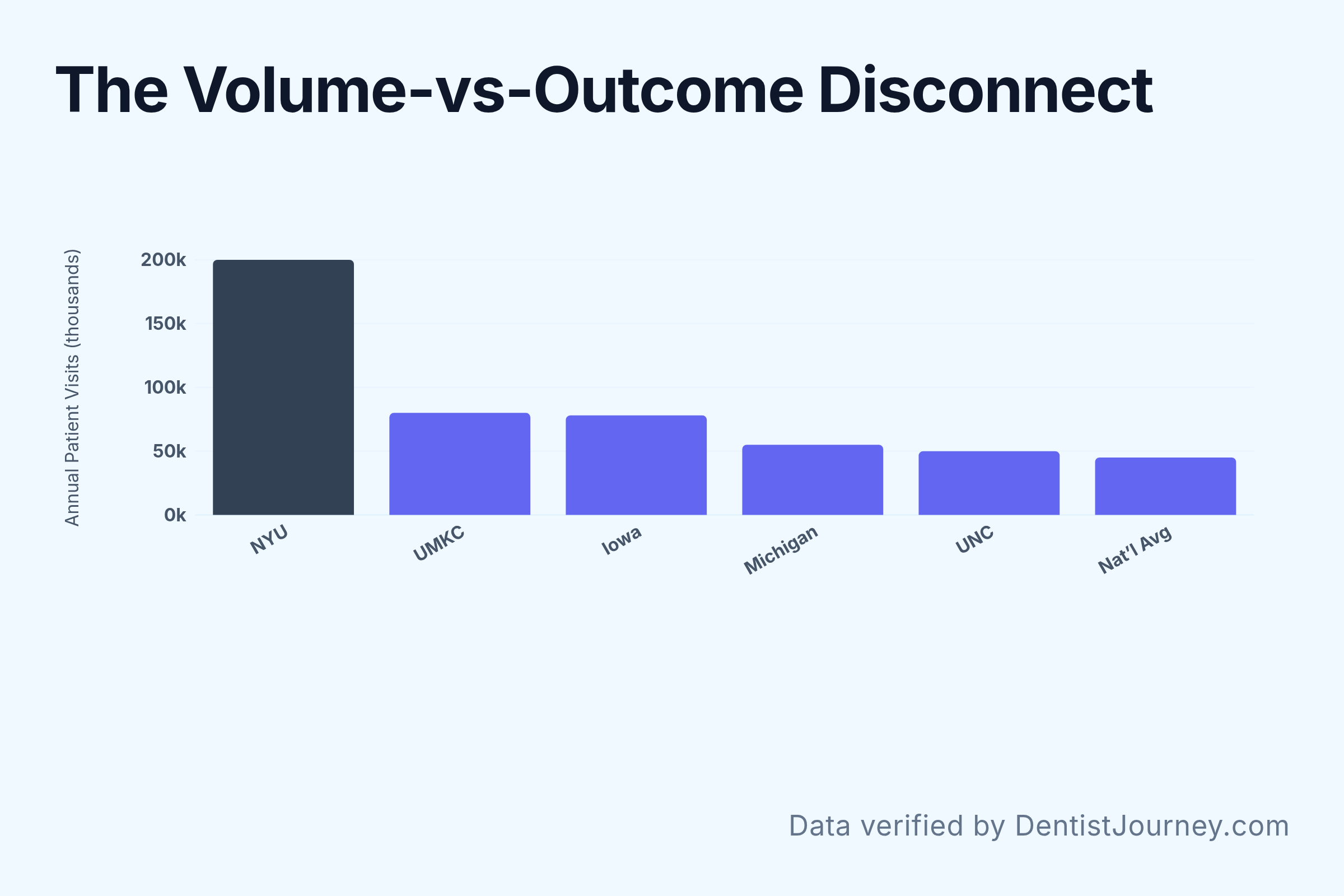
The NYU College of Dentistry operates the highest-volume clinical training program in the United States, treating over 200,000 patient visits per year, roughly 2.5 times the runner-up program. On paper, this should produce the most competent graduates in the country. In practice, NYU's INBDE first-time pass rate of 87.9% sits below the national average of 91%, and well below smaller programs that see a fraction of the patient volume.
Volume is not the same thing as skill. And the gap between the two is the single most overlooked factor in choosing a dental school.
The Throughput Numbers Nobody Talks About
NYU treats 200,000+ patient visits per year, 2.5x the runner-up program, yet posts an 87.9% INBDE first-time pass rate, below the 91% national average. The college operates one of the largest outpatient dental facilities in the world out of its Manhattan campus, serving a high-need, low-income patient population that flows through the clinic at industrial pace. For a pre-dent, the marketing pitch writes itself: more patients means more reps, more procedures, more confidence walking into residency.
The runner-up programs by clinical volume, including large state programs like UMKC and the University of Iowa, operate at roughly 40% of NYU's throughput. The median U.S. dental school sees a small fraction of that.
Now look at the outcome side of the equation. The INBDE (Integrated National Board Dental Examination, the U.S. dental licensing exam) first-time pass rate is the best way to compare competency across the 67 accredited U.S. dental schools. The national first-time pass rate for U.S. test-takers has hovered in the low 90s since the INBDE replaced Parts I and II.
NYU's most recently published first-time pass rate is 87.9%. That puts roughly 1 in 8 NYU graduates failing the boards on their first attempt, in a year when the national average failure rate was closer to 1 in 11.
For a program charging the highest tuition in the ADEA-reported dataset ($59,572 per year, more than double the median annual tuition of $61,748), that is a hard number to defend.
The Volume Paradox: Why More Patients Can Mean Less Learning
Past a certain point, more patient volume stops building skill. It thins out faculty supervision, narrows the variety of procedures, and cuts into board study time. That's a fair counterpoint, and worth examining honestly.
Rebuttal: the data shows the issue is structural, not demographic. Schools with rigorous didactic-to-clinical balance, like the University of Michigan and UNC Chapel Hill, post pass rates above 95% while serving similarly diverse patient populations. The variable isn't who the students are. The variable is how the clinical hours are structured.
High-volume programs face a basic operations tradeoff:
- Faculty-to-student ratio gets stretched. When a single instructor supervises 12 students working on 12 simultaneous patients, the depth of feedback per procedure drops.
- Procedure mix narrows. High-volume clinics see too many routine procedures (extractions, basic fillings) and too few of the complex cases that show up on board exams.
- Didactic time competes with chair time. Every hour a student spends meeting clinic requirements is an hour not spent on board prep.
This is the volume paradox. After a certain threshold, additional patient contact stops adding competency and starts subtracting study time.
The Price Tag of the Throughput Model
NYU charges $59,572 per year in tuition, among the highest in the ADEA dataset, while delivering a below-average 87.9% board pass rate, compared to Stony Brook's far lower tuition and 95%+ pass rate. NYU is the highest tuition in the ADEA-reported dataset at $59,572 per year. The national average tuition is $59,842, and the national median is $61,748. Across a four-year DDS program, an NYU student pays roughly $59,572 in tuition alone, before cost of living in Manhattan.
Compare that to Stony Brook, also in New York, where in-state tuition runs a fraction of NYU's $59,572 resident tuition and the board pass rate is consistently above 95%.
Hypothetical scenario: Student A enrolls at NYU at full sticker, graduating with roughly $511,000 in tuition debt and an 87.9% chance of passing boards on the first try. Student B establishes New York residency and attends Stony Brook, paying a fraction of that tuition with a higher first-time pass rate. The clinical hours look different on the resume. The five-year financial trajectory looks dramatically different.
NYU produces plenty of good dentists. The real question: does treating 200,000+ patient visits a year justify paying more than double the typical tuition for a below-average board pass rate?
The Action Plan: Read the Whole Scoreboard
Pre-dents should weigh four metrics together: clinical hours, faculty-to-student ratio, INBDE pass rate, and tuition. No single number predicts career outcomes. It's that no single metric, not volume, not ranking, not prestige, tells you whether a program is right for your career. Clinical hours matter. Faculty ratio matters. Board pass rate matters. Tuition matters. And the interaction between those four numbers matters more than any one in isolation.
If you're weighing high-volume programs against smaller, more mentored ones, the comparison needs to happen on every axis at once.
The applicants who get this right are the ones who stop optimizing for the most marketed metric and start optimizing for the best fit. Volume is a feature. It is not a guarantee.