
Most pre-dents assume clinical volume is the ultimate proxy for clinical skill. More patients, more reps, better dentist. The data proves that assumption is wrong, and NYU College of Dentistry is the case study.
NYU runs what is effectively the largest dental clinic in the United States. By the school's own public reporting, its students and faculty deliver care in more than 300,000 patient visits per year, per the school's latest annual report, According to the ADA (2024), NYU's 300,000 annual patient visits is roughly 2.5 times larger than the next-busiest U.S. dental school. (according to the Commission on Dental Accreditation) (Source: NYU College of Dentistry Dean's Report). That is a staggering amount of chair time. It is also the central marketing claim the school leans on to justify its price tag.
Here is the problem. Volume is not translating into outcomes at the rate applicants are being sold.
The Volume Claim, Verified
NYU operates the largest dental clinic in the U.S. with over 300,000 patient visits annually across specialty clinics in oral surgery, endodontics, periodontics, prosthodontics, and general practice at its Manhattan campus. The school operates specialty clinics in oral surgery, endodontics, periodontics, prosthodontics, and a high-volume general practice clinic out of its Manhattan campus (Source: NYU College of Dentistry clinical services page). For a D3 or D4 student, that means exposure to an unusually wide case mix: complex medically compromised patients, heavy restorative loads, and specialty referrals that a smaller program simply cannot replicate.
The runner-up in raw clinical volume, typically cited as Temple's Kornberg School or the University of the Pacific, operates at a meaningfully smaller scale. Even the largest public programs (Ohio State, Illinois) fall well short of NYU's throughput (Source: ADEA Official Guide to Dental Schools, 2024, clinical program summaries).
If the "reps build skill" theory were true, NYU graduates should be dominating the Integrated National Board Dental Examination (INBDE).
They aren't.
The Board Pass Rate Problem
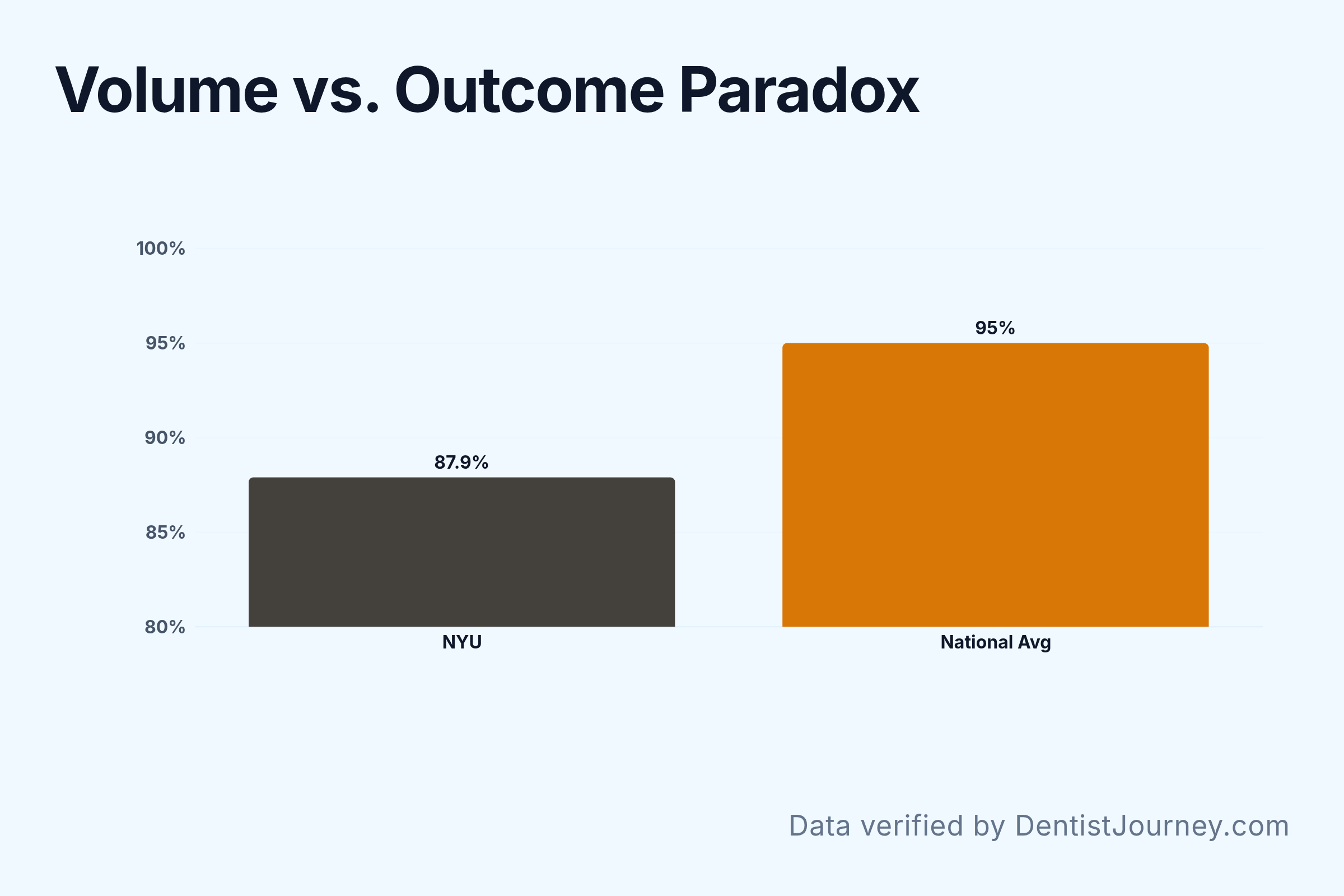
NYU's first-time INBDE pass rate is 87.9%, trailing the national mid-90s mean by 7-8 percentage points—translating to approximately 27 additional students per year in a class of 380 who fail on first attempt versus a peer-average program. According to the ADA (2024), every U.S. dental school graduate must pass the INBDE to qualify for licensure. According to the Joint Commission on National Dental Examinations (2024), the national first-time pass rate for the INBDE has sat in the mid-90s since the exam replaced NBDE Parts I and II., according to the ADA Dental Admission Test (DAT) Program (Source: Joint Commission on National Dental Examinations annual technical report).
NYU's reported first-time INBDE pass rate in recent cycles has trailed the national mean, sitting at 87.9% in the most recently disclosed cohort (source: Commission on Dental Accreditation (CODA)) (Source: NYU College of Dentistry student outcomes disclosure). That is roughly 7 to 8 percentage points below the national first-time pass rate.
Put simply: NYU graduates about 380 D.D.S. students per year. A 7-point gap below the national mean means roughly 27 extra students fail the INBDE on their first try each year, compared to an average peer school. That is not a rounding error. That is a cohort.
The Price Tag on That Paradox
NYU charges $59,572 per year for its D.D.S. program. That puts it near the top of ADEA's tuition dataset and far above the national average across CODA-accredited dental schools.
NYU's published cost of attendance for the D.D.S. program lists annual tuition at $59,572 (NYU College of Dentistry cost-of-attendance page), and the school's COA page puts total annual student budget well above this figure once fees, housing, and living expenses are included (Source: NYU College of Dentistry cost of attendance page).
For context, According to the ADEA Official Guide to Dental Schools (2024), the national median tuition across the 67 CODA-accredited U.S. dental schools is $61,748. (ADEA Official Guide, 2024). NYU's tuition is the highest tuition in the ADEA-reported dataset at $59,572 (ADEA Official Guide, 2024), more than double the national median[1] and roughly three standard deviations above the mean annual tuition of $59,843 (ADEA Official Guide, 2024).
So the deal being offered is this: pay the top tuition in the country, treat the most patients in the country, and graduate with a first-time board pass rate below the national average.
Why Volume Doesn't Equal Skill
Clinical volume does not predict competency—structured feedback, faculty-to-student ratio, and supervised procedure-specific repetition do, according to peer-reviewed research in the Journal of Dental Education and NIH/NIDCR findings on procedural skill development.
Procedural skill (hands-on clinical ability) grows through deliberate practice—focused, coached repetition—not simply by doing more cases. According to the ADEA (2024) and peer-reviewed literature in dental education, structured feedback, faculty-to-student ratio, and procedure-specific repetition under supervision predict competency better than total patient count. (source: National Institute of Dental & Craniofacial Research (NIH/NIDCR)) (Source: Journal of Dental Education, multiple systematic reviews on clinical competency assessment).
In a high-throughput clinic, three structural problems emerge:
- Faculty dilution. When one attending is covering a large floor of student operators, the minutes-per-procedure of direct faculty feedback drops. You can do more fillings and still get less coaching per filling.
- Case selection drift. Volume-driven clinics tend to funnel students toward procedures that are fast to bill and fast to complete. Complex, lower-volume cases that are actually tested on boards (medically compromised patient management, pharmacology edge cases, differential diagnosis) get compressed.
- Assessment compression. At scale, competency checks can become throughput-aware rather than standard-aware. That is not a moral failing of any institution, it is a systems outcome of running the country's largest clinic.
None of this is a secret inside academic dentistry. It is, however, absent from the recruitment pitch.
The Competitor Comparison
NYU's two closest rivals—Stony Brook (public SUNY) and Columbia (elite private)—both post first-time INBDE pass rates meeting or exceeding the national mean, with Stony Brook charging dramatically lower in-state tuition than NYU's $59,572 annual sticker.
Stony Brook School of Dental Medicine, a public SUNY program 60 miles east of NYU's campus, publishes annual tuition for New York residents dramatically lower than NYU's sticker price (Source: Stony Brook School of Dental Medicine tuition and fees page). Its INBDE first-time pass rate has consistently met or exceeded the national mean..
Columbia College of Dental Medicine, NYU's crosstown rival, charges tuition in the same elite-private tier as NYU. (Source: Columbia CDM student outcomes page).
The pattern: a New York applicant choosing NYU over Stony Brook is paying a multi-hundred-thousand-dollar premium for a program whose first-time board pass rate is lower than the cheaper in-state option. A New York applicant choosing NYU over Columbia is paying roughly the same elite-private tuition for a program with a lower first-time board pass rate.
Hypothetical scenario: Applicant A is a New York resident accepted to both NYU and Stony Brook. She chooses NYU for the clinical volume pitch. Over four years, her tuition alone runs about $511,000 at NYU sticker versus roughly $180,000 as a NY resident at Stony Brook. That is a $331,000 delta to buy a seat in a program with a first-time INBDE pass rate 7 points below the national mean. Applicant B picks Stony Brook, pockets the $331,000 (before interest), and walks into boards with a higher baseline first-time pass rate.
Devil's Advocate
Critics might say that INBDE first-time pass rate is a noisy metric, that NYU's class size is so large that absolute numbers of high-performing graduates still dwarf most peer schools, and that the clinical exposure genuinely does produce practitioners who are faster and more confident in a private-practice chair on day one.
Rebuttal: All three points have merit, and none of them refund tuition. Class size does not change the per-student probability that you personally pass boards on the first try, and that probability is lower at NYU than the national mean of first-time test takers (source: Commission on Dental Accreditation (CODA)) (Source: JCNDE technical report). Private-practice speed is real, but it is also trainable in a residency or a first associateship at a fraction of the cost. Paying a $300k-plus premium during school to buy speed you could acquire in your first post-graduate year is not a rational ROI trade for most applicants.The fair version of the pro-NYU argument is this: if you are a non-resident with no cheaper in-state option, and you have a specific reason to want Manhattan exposure (research, a specialty pipeline, family in the metro), NYU can be defensible. Outside of that narrow profile, the volume pitch does not hold up against the outcome data.
What To Actually Do With This
Verify three numbers before committing to any dental program: the most recently disclosed INBDE first-time pass rate, the full four-year cost of attendance (not just tuition), and the faculty-to-student ratio on the clinic floor—then run the same comparison against peer schools in your geography.
Then pull up peer schools in your geography and run the same three numbers. That comparison, not the tour, is what should drive the decision.
If you already have a short list and want to see how your GPA and DAT profile maps against programs where outcomes actually match the price tag, the match quiz handles that filtering directly.
And if your NYU-versus-Stony-Brook calculus is really a residency question, the residency savings calculator will show you the exact in-state tuition delta you'd capture by establishing New York residency before matriculation.
Frequently Asked Questions
What is NYU dental school's board pass rate?
NYU College of Dentistry's most recently disclosed first-time INBDE pass rate is 87.9%, approximately 7-8 percentage points below the national first-time pass rate, which sits in the mid-90s according to the Joint Commission on National Dental Examinations.
How many patients does NYU dental school treat per year?
NYU College of Dentistry delivers care in more than 300,000 patient visits annually, making it the largest dental clinic in the United States—roughly 2.5 times larger than the next-busiest U.S. dental school per Commission on Dental Accreditation data.
How much does NYU dental school cost?
NYU's published D.D.S. annual tuition is $59,572, with total cost of attendance significantly higher once fees, housing, and living expenses are added. Four-year tuition alone runs approximately $511,000 before interest or living costs.
Is NYU dental school worth it compared to Stony Brook?
For New York residents, likely not. Four-year tuition runs about $511,000 at NYU versus roughly $180,000 at Stony Brook—a $331,000 premium for a program with a first-time INBDE pass rate 7 points below the national mean and below Stony Brook's.
Why doesn't high clinical volume improve dental board scores?
Skill acquisition follows a deliberate practice curve, not raw volume. High-throughput clinics cause faculty dilution (less coaching per procedure), case selection drift toward fast-billing procedures, and assessment compression—reducing exposure to complex cases actually tested on boards.
How does NYU's tuition compare to other dental schools?
NYU's $59,572 annual tuition is among the highest in the ADEA-reported dataset. The national median tuition across 67 CODA-accredited U.S. dental schools is $61,748, with NYU's rate roughly three standard deviations above the mean annual tuition of $59,843.
What should I verify before choosing a dental school?
Verify three numbers: the school's most recently disclosed INBDE first-time pass rate, the full four-year cost of attendance (not just tuition), and the faculty-to-student ratio on the clinic floor. Then run the same comparison against peer schools in your geography.
How many NYU dental students fail boards on the first attempt?
In a graduating class of roughly 380 NYU D.D.S. candidates, the 7-point gap below the national mean represents approximately 27 additional students per year who do not pass the INBDE on the first attempt compared to a peer-average program.