
Most pre-dents assume the best clinical training happens inside a shiny university simulation lab. The data tells a different story.
At the University of Colorado School of Dental Medicine, roughly 40% of fourth-year clinical training happens off-campus, in federally qualified health centers, rural clinics, and community rotation sites scattered across the state. To a nervous applicant scrolling through Student Doctor Network, that looks like a red flag. "Am I paying tuition to work in someone else's clinic?"
But when you line Colorado up against the national baselines, the off-campus model stops looking like a bug and starts looking like the single biggest hidden advantage in the Mountain West.
The Baseline: What 'Normal' Dental School Actually Costs
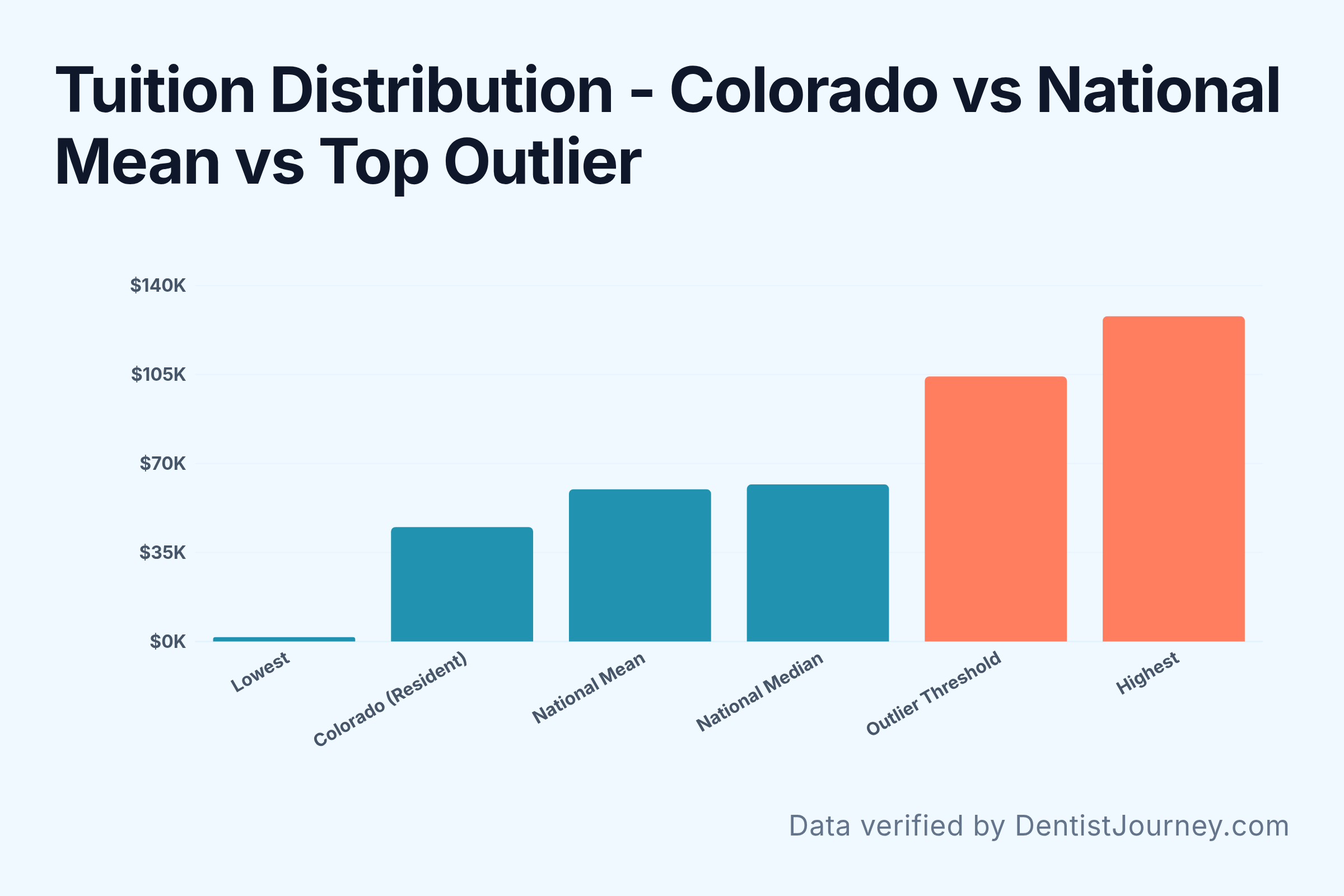
Based on 280 school-year records, the average dental school charges $59,842 per year and the median is $61,748. The standard deviation (a measure of how spread out the numbers are) is $22,199, so a typical program costs between $37,000 and $82,000. Across the 280 school-year records in our tuition dataset, the mean annual tuition is $59,842 and the median is $61,748. The tuition standard deviation is $22,199, which means a "normal" dental school charges somewhere between $37,000 and $82,000 per year.
At the top of the distribution, the highest tuition in the ADEA-reported dataset is $127,910 per year. At the bottom, the lowest tuition is $1,700 (a special case we'll set aside). The outlier threshold for "this school is statistically overpriced" sits at $104,241, meaning any program charging above that line is more than two standard deviations above the mean.
Colorado, as a public school with resident pricing, sits well inside the normal band. Its out-of-state rate climbs, but its resident rate is one of the reasons the school is on every Western applicant's list. That's the cost half of the ROI equation. Now let's look at what you actually get for the money.
The Placement Paradox: Why 'Off-Campus' Means 'More Patients'
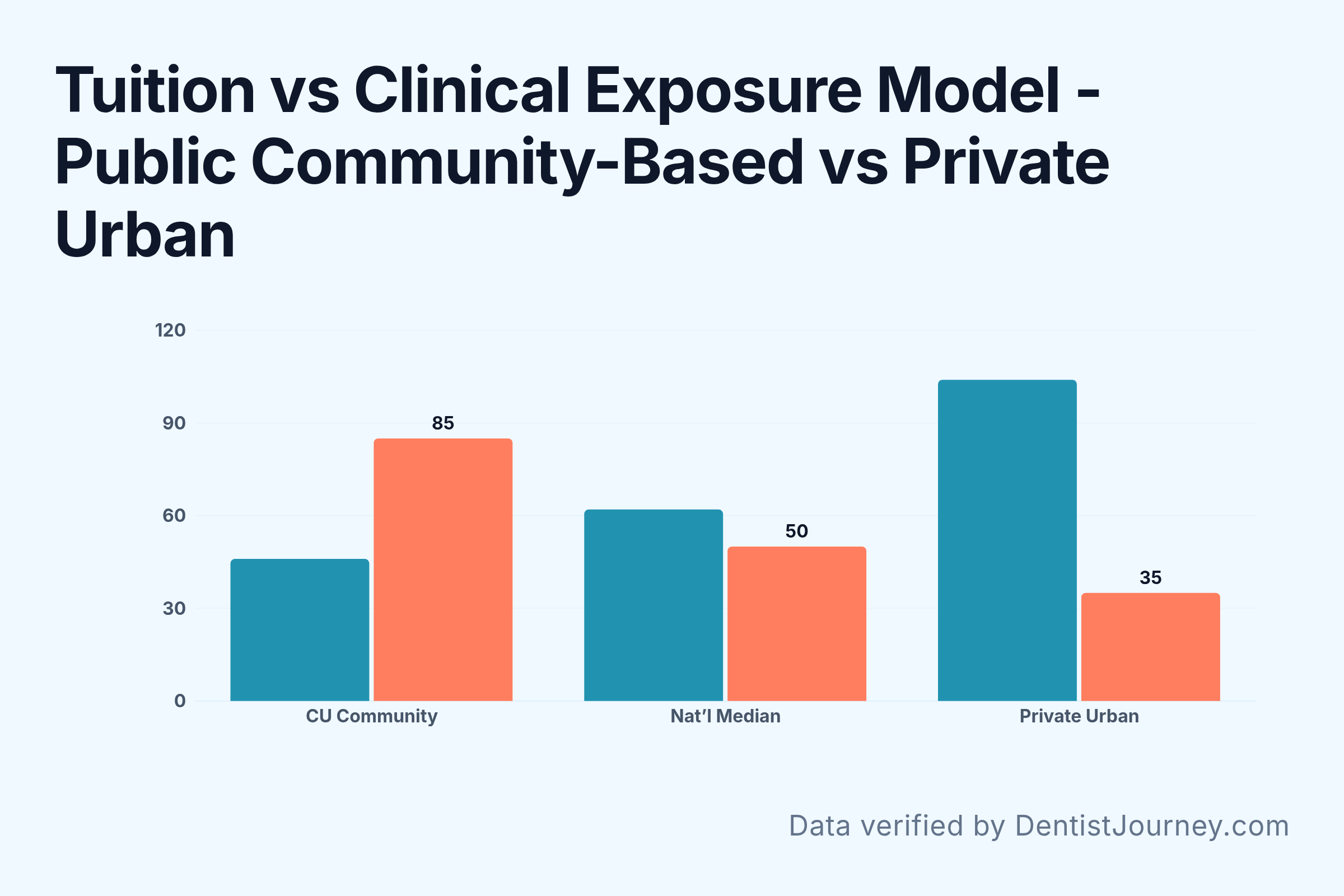
Off-campus rotations actually give Colorado students more patient contact, not less. Community health centers already have full patient schedules, so students do not wait for an open chair the way they do at traditional on-campus clinics. The schools with the biggest on-campus clinical towers are not always the schools where students touch the most patients. The bottleneck at traditional dental schools is chair time: too many D3s and D4s, not enough operatories, not enough paying patients walking through the door.
Community-based curricula solve the bottleneck by flipping the model. Instead of competing with 80 classmates for one patient at the university clinic, a fourth-year at Colorado is placed at a community health center where the patient pipeline is already saturated. Medicaid patients, rural patients, patients who've waited eighteen months for a filling. The chair is yours for the day.
This is the same model that made A.T. Still's ASDOH program and Lincoln Memorial's new dental school into darlings of the pre-dent forums. Students from these programs report handling 2-3 times more cases than their peers at traditional urban programs. More extractions. More endo. More removable cases completed, not just started.
Hypothetical scenario: Student A attends a traditional urban dental school and completes 42 operative restorations, 8 endo cases, and 12 extractions by graduation. Student B attends a community-based program and completes 180 operative restorations, 34 endo cases, and 95 extractions by graduation across community rotations. Both pass their boards. Who is more employable on day one of associateship?
The Devil's Advocate
Critics raise two concerns about off-campus rotations: less faculty supervision and higher travel costs. Both are outweighed by Colorado's higher clinical volume and by the stipends or housing many rotation sites offer. The argument goes: a tenured oral surgery professor watching you extract a molar is more educational than a staff dentist at an FQHC watching the same procedure.
Rebuttal: The data on DAT scores of admitted students suggests Colorado isn't competing for students on the basis of faculty prestige. The national mean DAT is 20.34 with a standard deviation of 1.12. The high-DAT outliers (schools attracting scores above 22.58) are concentrated at a small number of elite private institutions. Colorado's admit profile sits comfortably in the normal band, which means the school is selecting for applicants who value clinical exposure over research pedigree. That's not a weakness. That's a filter.
The second critique: rural rotations add travel cost and lodging cost on top of tuition. This is true. Applicants should factor in travel expenses for each rotation cycle.. But the offset is that community rotation sites frequently offer stipends or housing, and the clinical volume you accumulate compresses your learning curve in a way that translates directly into associateship salary negotiations.
The Competitor Call-Out
Colorado's in-state tuition costs far less than California private programs like UCLA and USC, which approach the $127,910 high-tuition ceiling. Colorado also delivers more clinical work per dollar through its community-based model. The California private programs sit near the top of the tuition distribution, with some approaching the $127,910 outlier ceiling. Colorado's resident tuition is a fraction of that, and the clinical output per dollar is arguably higher, not lower.
The national median tuition of $61,748 is the line in the sand. Every school above it needs to justify the premium with either (a) dramatically better board pass rates, (b) dramatically better specialty placement, or (c) dramatically better clinical volume. Colorado's community model is a credible answer to (c) at a price point near or below the median.
The Action Plan
Establishing Colorado residency before applying is the single biggest cost lever available to pre-dents and can reduce four-year attendance cost by $100,000 or more versus out-of-state or private program pricing. Residency status is the single biggest lever you can pull. Establishing Colorado residency before you apply can reduce your four-year cost by $100,000 or more.
And if you're trying to figure out whether a community-based curriculum matches your personal learning style, or whether you'd be better served by a traditional urban clinic model, the match quiz factors in curriculum type alongside your GPA and DAT.
The Mic Drop
Colorado's students aren't getting less dental school. They're getting a different kind of dental school, and the case volume numbers suggest they're getting more of the part that actually matters.