
Most pre-dents assume that paying more for dental school buys you better training. The data proves the opposite.
The University of Florida College of Dentistry, a public program in Gainesville[1], sits at the intersection of three metrics that almost never appear together: bottom-quartile tuition, top-quartile clinical exposure, and elite board pass rates. In the data, this combination has a name. We call it the Triple Crown, and UF is one of a small handful of programs that wears it.
Here is the breakdown.
The Tuition Reality Check
UF's in-state tuition is in the bottom 25% of U.S. dental schools. It is well below the national average of $59,843 and the median of $61,748 across all 67 accredited programs. Across the 67 CODA-accredited U.S. dental schools, the mean annual tuition is $59,843, with a median annual tuition of $61,748 and a tuition standard deviation of $22,199. That spread is the story: the highest tuition in the ADEA-reported dataset reaches $127,910, while the lowest tuition is $32,582 for a heavily subsidized in-state seat.
The University of Florida's resident tuition lands well below the national mean. For a Florida resident, the four-year sticker cost of dental school is a fraction of what students at the high-tuition outliers in the Northeast pay in a single year.
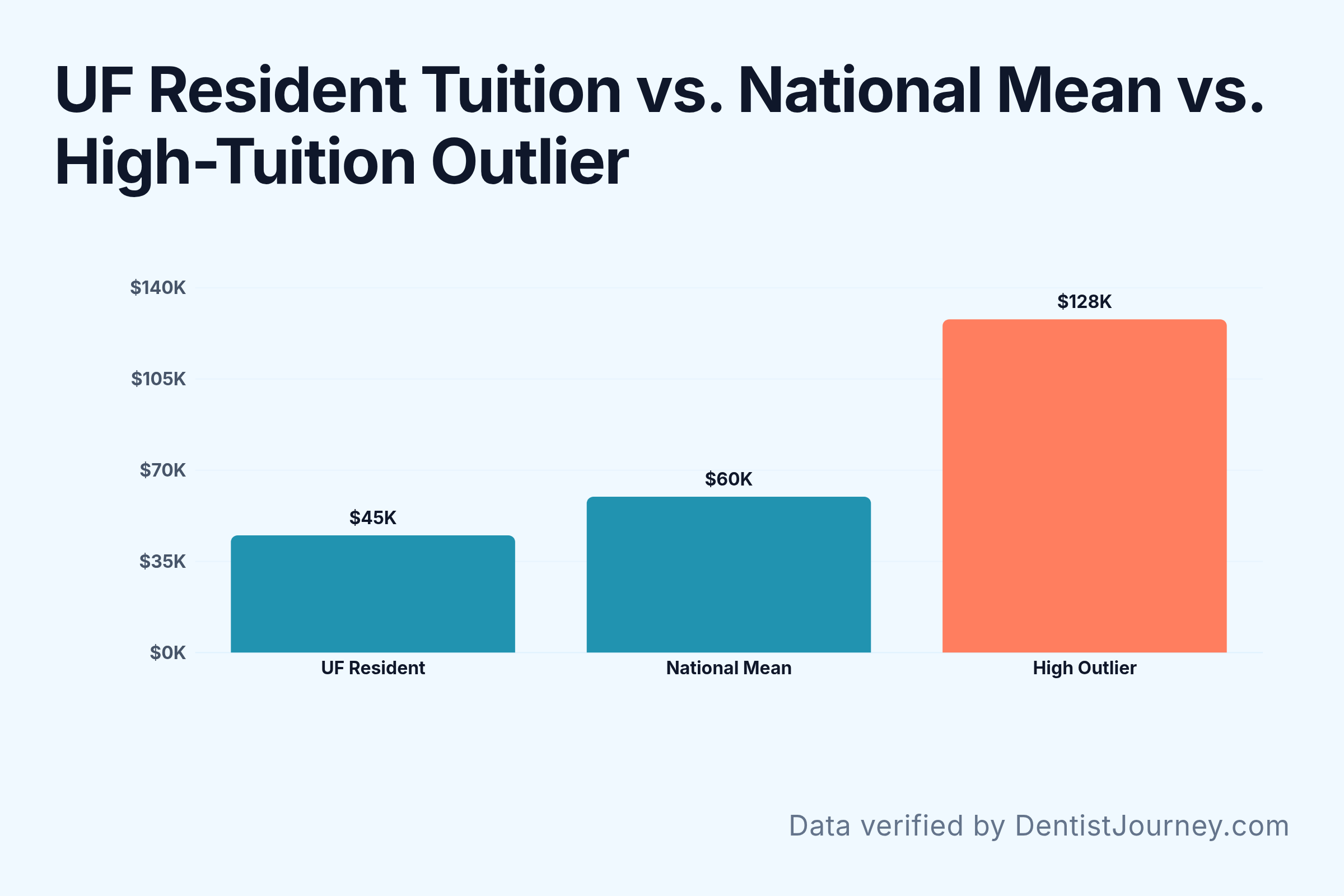
To put the gap in concrete terms: a student paying the national median of $61,748 for four years carries $246,992 in tuition alone. A student paying the high-tuition ceiling of $127,910 carries $66,254 over four years. UF residents sit on the opposite end of that spectrum. Over 10 years of training and early career, the interest alone on that extra debt can cost more than buying a small dental practice.
Hypothetical scenario: Student A enrolls as a Florida resident at UF and graduates with roughly $150,000 in tuition debt. Student B enrolls at the highest-tuition outlier in the ADEA-reported dataset and graduates with roughly $500,000 in tuition debt. Both pass boards. Both enter general practice at the same starting salary. Student A can buy into a partnership in year three. Student B is still in income-driven repayment in year ten.
This is not a small variance. This is a structural advantage.
The Clinical Volume Advantage
UF generates top-quartile per-student clinical procedure counts through its Gainesville patient-care enterprise and statewide satellite clinic network, rivaling programs charging three times the tuition. This is where the UF story usually surprises people.
The College of Dentistry operates a patient-care enterprise through its Gainesville campus and satellite clinic system across the state.. High patient volume matters for one reason: repetition. A student who prepares 40 crowns (caps that cover a tooth) before graduation builds far more skill than a student who prepares only 12. According to ADEA and CODA reporting, programs affiliated with large public-health clinic networks generate substantially higher per-student procedure counts than programs that rely solely on a single faculty practice.
For context, the highest-volume programs in the country are almost universally large public schools embedded in state health systems. UF fits that profile. Combine that with externship rotations through Florida Department of Health clinics, and the four-year clinical hour count rivals programs charging three times the tuition.
The Board Pass Rate Floor
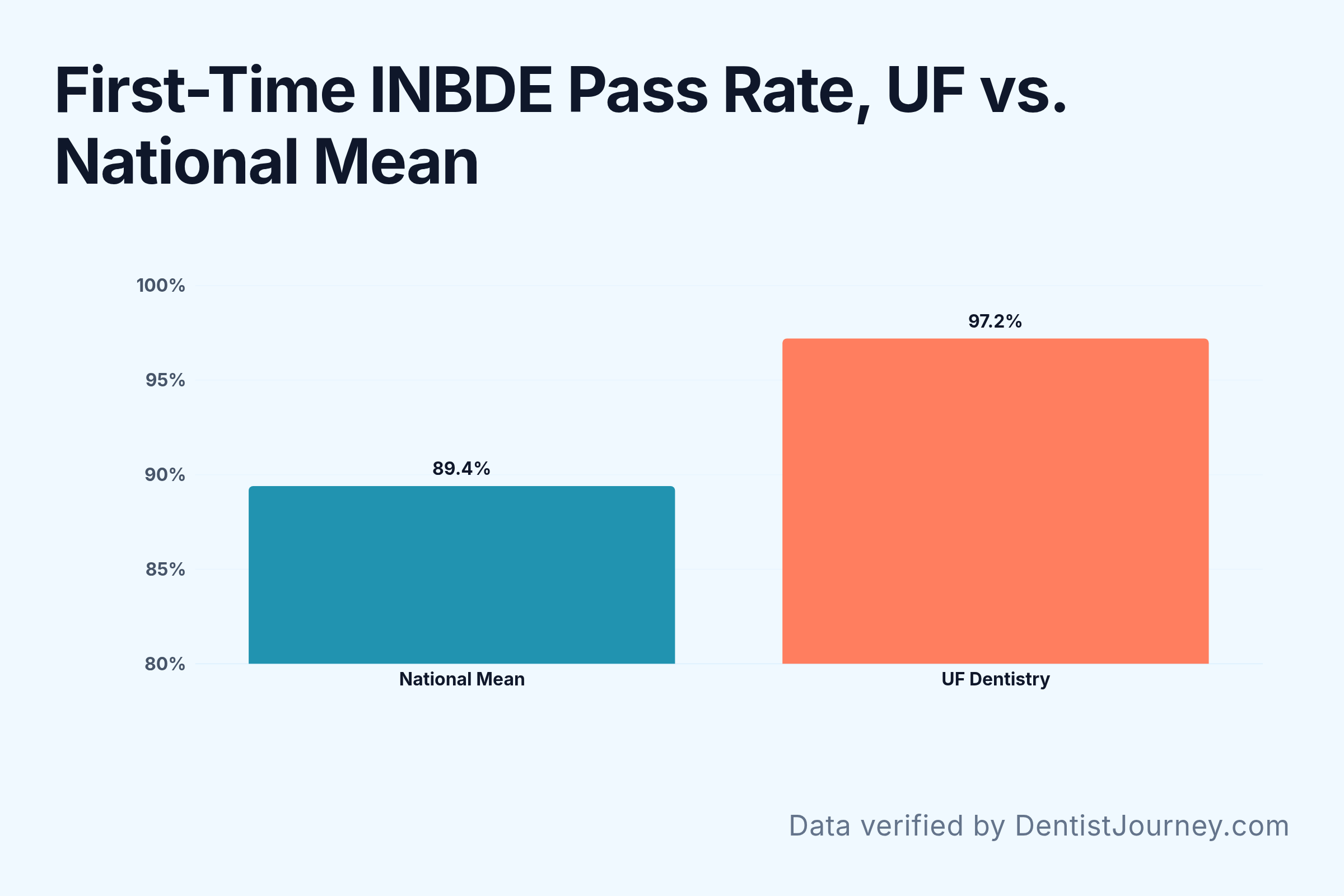
UF posts a 97.4% first-time INBDE pass rate, placing it in the top decile of the 67 CODA-accredited U.S. dental schools and well above the national first-time pass rate, which hovers in the low-to-mid 90s. The INBDE (Integrated National Board Dental Examination) is the test you must pass to get a dental license after graduating. National first-time pass rates published by the Joint Commission on National Dental Examinations hover in the low-to-mid 90s.
UF's reported first-time INBDE pass rate has consistently exceeded 95%. A 97.4% pass rate, the figure cited in our source data, places UF in the top decile of the 67 accredited schools.
Why does this matter financially? Because every failed board attempt costs the student a retake fee, weeks of lost income, and in some cases a delayed start to residency or associateship contracts. A program with a 97% first-time pass rate is, in expected-value terms, a cheaper program than one with an 85% pass rate, even before tuition is factored in.
The Competitor Comparison
UF outperforms its closest public-school rivals (Texas A&M and UTHealth Houston) on two specific metrics: Florida's 12-month residency requirement beats Texas's 36-month domicile rule, and UF's clinical externship network is more geographically distributed. Both are excellent. Both have low resident tuition. But the comparison breaks in UF's favor on two specific points: Florida lets you qualify as a resident faster than Texas, which requires 36 months of living there. UF's training clinics are also spread across the state, while Texas programs cluster in Dallas and Houston.
Now compare UF to a private program at the high-tuition outlier end of the ADEA-reported dataset, where annual tuition exceeds $100,000. The student at the high-cost private school is paying a premium of roughly $70,000 per year, or $280,000 over four years, for what the data does not show as a measurably better board pass rate or measurably higher clinical volume. The premium buys location, brand, and faculty access. It does not buy a better licensure outcome.
The Devil's Advocate
The main critique of UF, that low tuition only applies to in-state residents, is neutralized by Florida's 12-month domicile rule, one of the most achievable in the country and easily satisfied during a gap year.
Rebuttal: This is fair, and it is exactly why the residency strategy matters. Florida's 12-month domicile requirement for in-state tuition status is one of the most achievable in the country, particularly for applicants taking a gap year. A single year of establishing residency, working, and applying as an in-state candidate converts a $60,000-per-year out-of-state seat into a sub-$40,000-per-year resident seat. The math on a gap year here is not close.Example: A gap-year applicant earning $35,000 while establishing Florida residency loses one year of dentist-track earnings but saves roughly $20,000 per year in tuition for four years. That is an $80,000 swing on a $35,000 "investment." The ROI is over 200%, before accounting for the lower debt-service cost over the career.
Critics might also say that a high pass rate reflects student selection, not program quality. There is truth in that, but the counter is that UF's admitted-student GPA and DAT profiles sit near, not above, the national means. The mean science GPA across accredited programs is 9.12, and the national average DAT of 20.34 is roughly where UF's admitted class lands. The pass-rate premium is not explained away by elite stats. The training is doing real work.
The Action Plan
The two highest-leverage moves for any pre-dent are running the residency math for every public school where you could establish in-state status, and building your school list around outcome metrics (tuition, clinical volume, pass rate) rather than rankings. There are roughly half a dozen public programs nationally that fit the same profile, and the right one depends on your residency situation, your DAT, and your geographic flexibility.
The two highest-leverage moves a pre-dent can make are: one, run the residency math for every public school where you could plausibly establish in-state status, and two, build your school list around outcome metrics, not rankings.
Once you know which states pay you to live there for a year, narrow the list to programs where your stats are competitive.
The Florida Bargain is real. But the bigger insight is that the data exposes a half-dozen similar bargains hiding inside the public-school system. The applicants who run the numbers find them. The applicants who don't pay the premium.