
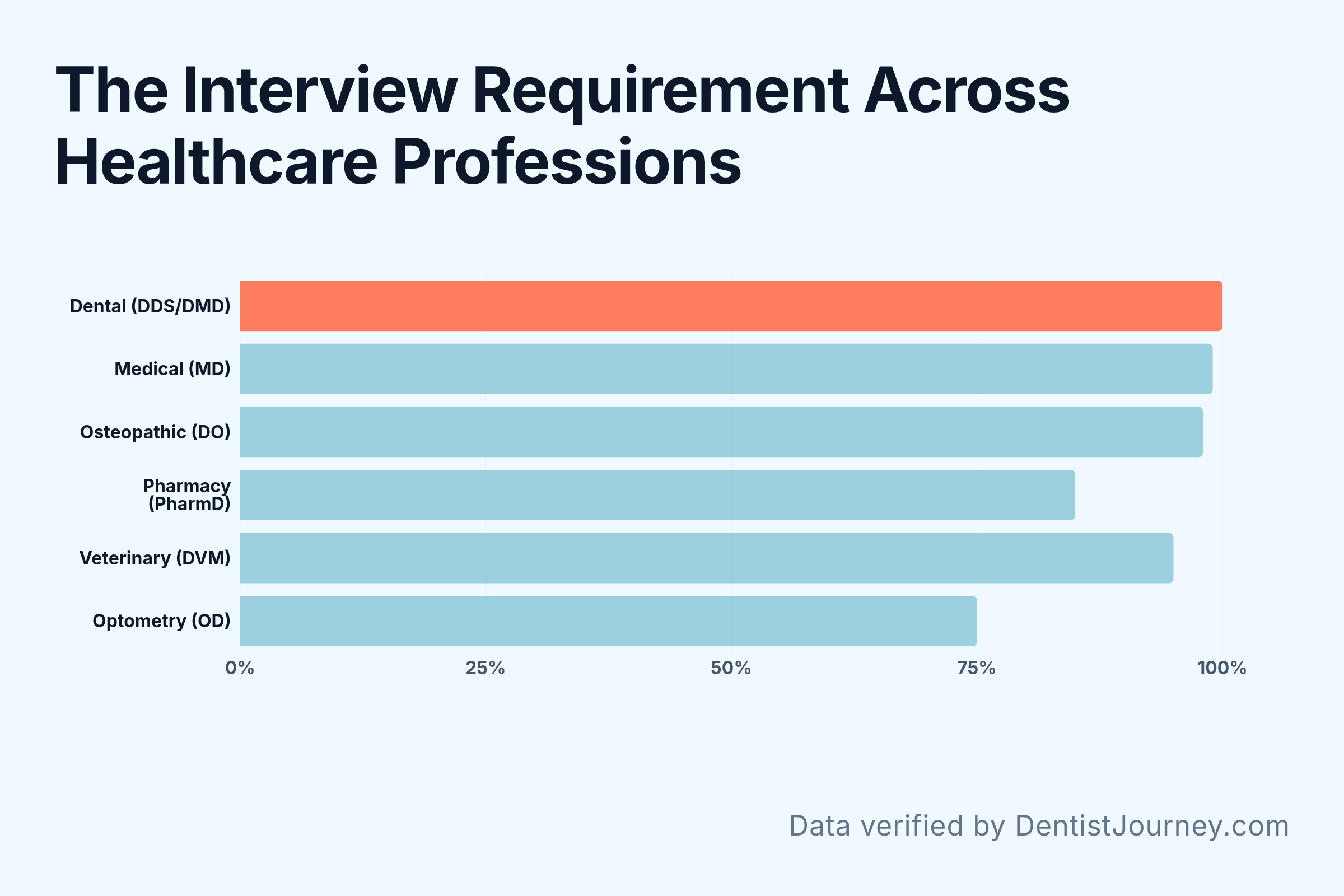
Most pre-dents assume that if your GPA is high enough and your DAT score is shocking enough, the interview becomes a formality. The data says the opposite. According to the ADEA Official Guide to Dental Schools, every CODA-accredited dental program in the United States, all 67 of them, requires an in-person or virtual interview as a non-negotiable condition of admission.
Not 95%. Not 98%. One hundred percent.
For context, that is not how medical school works. According to AAMC data, M.D. programs require interviews as part of their standard admissions process. Dentistry has zero exceptions. The interview is the wall, and there is no door around it.
The 100% Rule Is Not An Accident
Every dental school requires an interview for one reason: dentists do fine-motor work (precise hand skills) just inches from awake patients. That kind of soft-skill profile can only be tested in person, according to ADA and BLS data. The ADA's career outlook materials describe dentistry as a procedural specialty where practitioners spend the majority of clinical hours performing fine-motor work inches from a conscious patient's face. Per the U.S. Bureau of Labor Statistics Occupational Outlook Handbook for Dentists, dentists spend the majority of their working hours on direct patient care.
No other healthcare profession concentrates this much close-contact, real-time procedural work with conscious patients. Admissions committees see the interview as the only way to test the soft skills the job requires: staying calm, communicating under stress, working with steady hands, and keeping a patient at ease.
The second reason is financial. According to ADEA, dental education is one of the most resource-intensive degree programs in U.S. higher education. The national average tuition is $59,843 per year, with a tuition standard deviation of $22,199 across CODA-accredited programs, per the ADEA Official Guide. Each accepted student locks the school into four years of clinical training costs (lab space, equipment, faculty time) that the school cannot get back if the student drops out. The interview is the school's last chance to assess fit before that commitment is locked in.
The Numerator vs. The Denominator
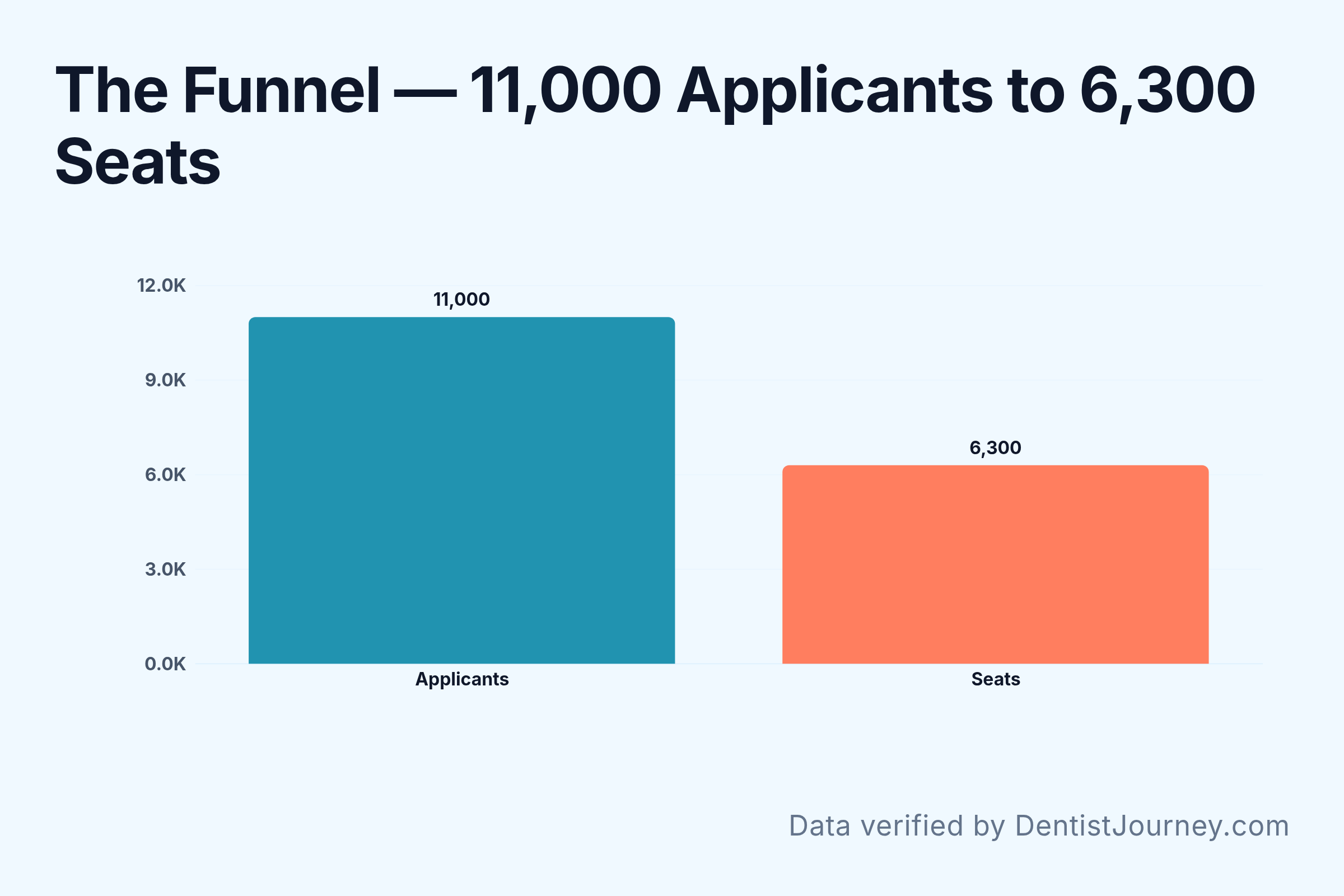
Over 11,000 applicants compete annually for roughly 6,300 first-year dental school seats across 67 CODA-accredited programs, per ADEA's 2024 cycle data, making the interview the chokepoint where the pool is cut nearly in half. According to ADEA's 2024 application cycle data, the national applicant pool exceeds 11,000 candidates per cycle competing for roughly 6,300 first-year seats across the 67 CODA-accredited schools. Of those 11,000+ applicants, only a fraction are invited to interview. And of those interviewed, schools admit only what they can seat.
The interview is the chokepoint where the 11,000 becomes 6,300.
That means your DAT score and GPA do not get you in. They get you to the interview. According to ADEA data, the national mean DAT score among matriculants is 20.34 and the mean science GPA among matriculants is 3.60. Those numbers are the floor for getting an invitation, not the ceiling for getting an acceptance.
Format Matters More Than Most Applicants Realize
Dental schools use three interview formats per ADEA program profiles: traditional one-on-one or panel interviews, Multiple Mini Interview (MMI) stations of 6-10 rotations lasting 5-8 minutes each, and hybrid formats combining both. Per ADEA's program-by-program admissions profiles, dental schools use three formats:
- Traditional one-on-one or panel interviews (the legacy format)
- Multiple Mini Interview (MMI) stations, modeled after medical school MMI protocols
- Hybrid formats combining a panel interview with situational scenarios
In the MMI (Multiple Mini Interview), candidates move through short timed scenarios. Each station tests one skill: ethics, communication, or how you handle conflict. According to ADEA program profiles, schools using MMI typically run between 6 and 10 stations of 5 to 8 minutes each. The format is designed to neutralize the influence of a single bad rapport with a single interviewer, which means a candidate who flubs station 1 can recover by station 5.
A traditional panel, by contrast, gives you one shot with one room of evaluators. If the chemistry is off, there is no second station to fix it.
Virtual Interviews Are Now the Default, Not the Exception
The majority of CODA-accredited dental programs now offer virtual interviews as the primary or co-equal format to in-person, per ADEA's 2023-2024 annual survey, though the interview itself remains universally required. By the 2023-2024 cycle, the majority of CODA-accredited programs offered virtual interviews as either the primary format or a co-equal option to in-person, per ADEA's annual survey of dental school admissions practices.
This matters for two reasons. First, it cut the travel cost. In the past, applicants from lower-income families often could not afford to fly to 8 different interview cities. Second, virtual format does not lower the bar. The wall is still the wall. The interview is still required.
The Devil's Advocate
Critics might say: "A 100% interview requirement is just bureaucratic theater. If a student has a 4.0 GPA and a 25 DAT, what is an interview really going to reveal?"Rebuttal: The data on attrition tells a different story. Dental education involves clinical training where students physically perform irreversible procedures on real patients starting as early as their second year. A candidate with elite academic metrics but poor manual composure or weak interpersonal calibration is a clinical liability the school cannot absorb. According to ADEA, the average cost of educating a single dental student exceeds the tuition they pay, meaning every washout is a net institutional loss. The interview is not theater. It is risk management on a four-year, six-figure commitment.
What This Means For Your Application Strategy
Interview preparation is the highest-leverage step in a dental school application because 100% of programs require an interview and it is where 11,000+ applicants are reduced to 6,300 admitted seats—yet most applicants spend under 10 hours preparing for it. It is the highest-leverage step. Yet most applicants spend 200+ hours on the DAT and fewer than 10 hours practicing interview answers.
Hypothetical scenario: Applicant A scores a 22 DAT and a 3.85 GPA and spends 6 hours skimming a list of common interview questions the night before. Applicant B scores a 20 DAT and a 3.55 GPA and runs 15 timed mock MMI stations across two months. At the interview, Applicant B's composure and station-to-station consistency outperform Applicant A's improvisation. Both interview at the same school. The school admits Applicant B.
This pattern is not rare. It is the structural logic of why the interview exists.
The Bottom Line
The dental school interview—required by 100% of CODA-accredited programs with no exceptions—is the true gatekeeper of admissions; DAT scores and GPA only earn the invitation, per ADEA. Per ADEA, those are the entry tickets. The Gatekeeper is the interview, and it applies universally to every single CODA-accredited program in the country. There is no school where you can skip it. There is no score high enough to bypass it. There is no shortcut.
The applicants who treat the interview as an afterthought are competing against the applicants who treat it as the main event. Per ADEA's funnel math, only one of those groups gets the seat.
If you want to see how your stats line up against the schools you are targeting before you get to the interview stage, start here: