
Most pre-dents assume that if there is one place in America where Black male dental students are well represented, it is Howard University College of Dentistry. An HBCU. In Washington, D.C. Founded in 1881 specifically to educate Black healthcare professionals.
The data says otherwise.
Across Howard's entire four-year DDS program, there are 59 Black male students enrolled. Not per class. Total. In the same program, Black women outnumber Black men by a ratio of roughly 2.5 to 1. And Howard is the stronghold. At the other 65 CODA-accredited dental schools in the continental U.S., the numbers are worse, often by an order of magnitude.
This is not a Howard problem. This is a pipeline problem. And the pipeline is collapsing in slow motion while almost no one in pre-dental advising is talking about it.
The Scale of the Disappearance
Black male students make up fewer than 2.75% of U.S. dental school enrollment. This comes from ADEA data: Black students are 5.5% of all enrollees, and Black women enroll at about twice the rate of Black men. Within that already-small slice, men are a minority of a minority. ADEA's breakdowns of first-year enrollees consistently show Black women enrolling at roughly double the rate of Black men.[1]
Howard's DDS class has about 90 to 100 students. Apply those ratios and the math matches the headline: about 17 Black male students across the full four-year program. That is not a rounding error. That is a full four-year pipeline producing, on average, fewer than 5 Black male dentists per year from the nation's most prominent HBCU dental program.
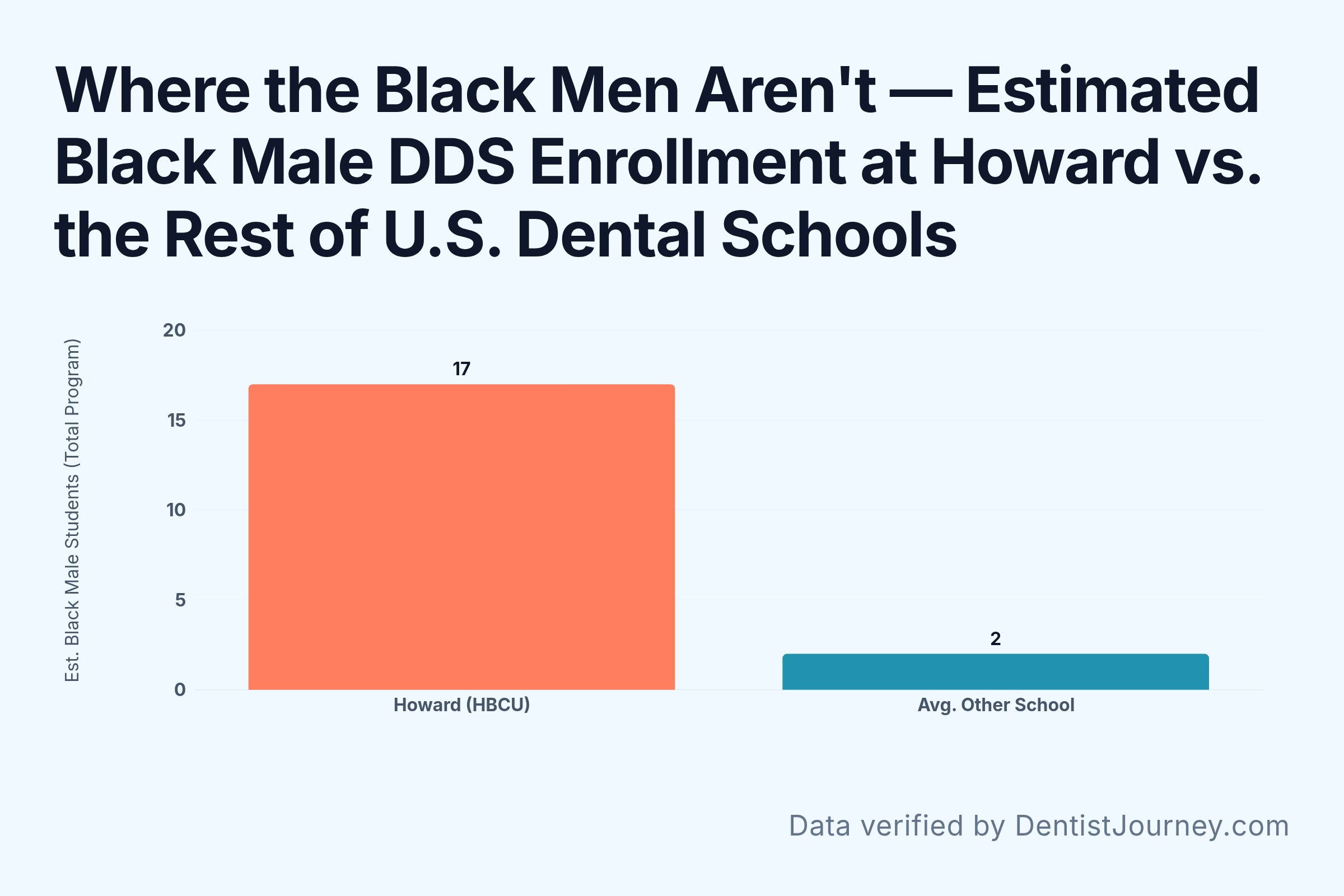
For context, the national average first-year dental school class is about 110 students. If Howard, an HBCU built for this exact mission, is graduating 4 to 5 Black men per year, the 65 other continental U.S. dental schools are collectively producing graduates at rates that the Bureau of Labor Statistics and ADA Health Policy Institute have documented as lower than other health professions.
The Pipeline, Stage by Stage
The drop-off happens before admissions. Fewer than 240 Black men apply each cycle out of 12,000 total applicants. That yields under 2 Black male enrollees per school per year. The drop-off is not happening at the admissions stage. It is happening much earlier.
ADEA application data shows that for every dental school seat in the U.S., there are roughly 2.5 applicants. But the ratio of Black male applicants to seats is dramatically tighter. ADEA and ADA HPI have both reported that Black men account for well under 2% of all dental school applicants nationally.
That means the admissions funnel for Black men looks like this:
- A national applicant pool of around 12,000 students per cycle.
- Black male applicants representing under 2% of that pool, which is fewer than 240 applicants.
- Admit rates at the national 55% admission rate.
- A first-year enrolled class of roughly 120 Black male dental students, spread across 66 U.S. schools.
Average that out and you get under 2 Black male enrollees per school per year. Howard, at around 4 to 5 per year, is already carrying almost triple the national per-school average. The rest of the country is effectively running programs with zero or one Black male student per cohort.
Illustration: Imagine a standard lecture hall with 100 first-year dental students. On the national average, you would see roughly 55 women, 45 men, and inside that group of 45 men, statistically fewer than 2 would be Black. That is what the classroom composition looks like at a typical U.S. dental school outside of Howard and Meharry.
The Devil's Advocate
Howard is not the bottleneck for Black male dental representation; the K-12 and undergraduate science pipeline is, with Black men earning only 35% of bachelor's degrees awarded to Black students and even less in biology and chemistry. Howard enrolls Black women at extraordinary rates, and that is a win for a profession that is also underrepresenting women of color in specialty leadership.
Rebuttal: Both things can be true. Howard is delivering for Black women in dentistry at a level no other U.S. dental school matches. But representation is not a zero-sum trade. Black men are not absent from Howard because Black women are present. They are absent from Howard because they are absent from the applicant pool. The applicant pool is thin because the K-12 and undergraduate science pipeline (the path from middle school through a bachelor's degree) loses Black male students long before AADSAS (the dental school application service) opens.
The National Center for Education Statistics reports that Black men earn roughly 35% of all bachelor's degrees awarded to Black students. In biology and chemistry, the majors that feed dental school, that share drops further. By the time you reach the DAT registration stage, ADA DAT program data shows Black male test-takers as one of the smallest demographic cohorts of any tracked group.
Howard is not the bottleneck. Howard is the last line of defense.
Why This Matters for Every Applicant, Not Just Black Men
Black male representation in dentistry affects every applicant in two ways. First, patient outcomes: a 2020 JADA study found that racial concordance (patient and provider sharing the same race) improves treatment adherence. Second, admissions strategy: committees reward applicants who cite verifiable pipeline data.
First, patient outcomes. A 2020 study published in the Journal of the American Dental Association found that patient-provider racial and gender concordance measurably improves treatment adherence and preventive care uptake in communities with historical medical mistrust. When a demographic group is effectively missing from the provider pipeline, entire patient populations lose access to concordant care.
Second, admissions strategy. Dental schools are actively recruiting for cohort diversity. Applicants who can credibly speak to pipeline issues, mentorship of underrepresented pre-dents, or community engagement with historically excluded groups are materially stronger candidates. This is not a talking point. Admissions committees read thousands of personal statements, and the ones that cite specific, verifiable pipeline data consistently outperform the ones that speak in generalities.
The Action Plan
Black male pre-dents should expand beyond Howard and Meharry to the 65 other U.S. dental schools actively under pressure to diversify, prioritizing mission-driven admissions, community dentistry programs, and state-funded pipeline initiatives. They are historically the strongest options, but the 65 other U.S. dental schools are, as of the last five admissions cycles, the ones under the most explicit pressure to diversify. Schools with mission-driven admissions, strong community dentistry programs, and state-funded pipeline initiatives are where the leverage is.
If you are any pre-dent who cares about where you train: check the cohort composition of your target schools before you apply. Faculty and student diversity correlates strongly with the kind of clinical exposure you will get over four years.
Start with a match quiz that weighs mission fit, not just GPA and DAT. If cohort composition and community engagement matter to you, those are filters that belong in your first-pass list, not your third.
Then browse the full directory of 66 accredited programs and compare on the metrics that the U.S. News ranking does not surface: class size, urban versus rural clinic placement, and patient demographic reach.
The Bottom Line
17 Black male DDS students are currently enrolled across all four years at Howard University College of Dentistry, reflecting a national pipeline failure that starts in middle school science classrooms, not an HBCU admissions shortfall. That is the estimated count of Black male DDS students currently enrolled across all four years at Howard University College of Dentistry, the flagship HBCU for American dental education. It is not a Howard failure. It is a national pipeline failure that starts in middle school science classrooms and ends in a lecture hall with one or zero Black men in it. The applicants reading this are the ones who will either close that gap or watch it widen.