
Most pre-dents treat Tufts as a safety school. The application data proves that label is a decade out of date.
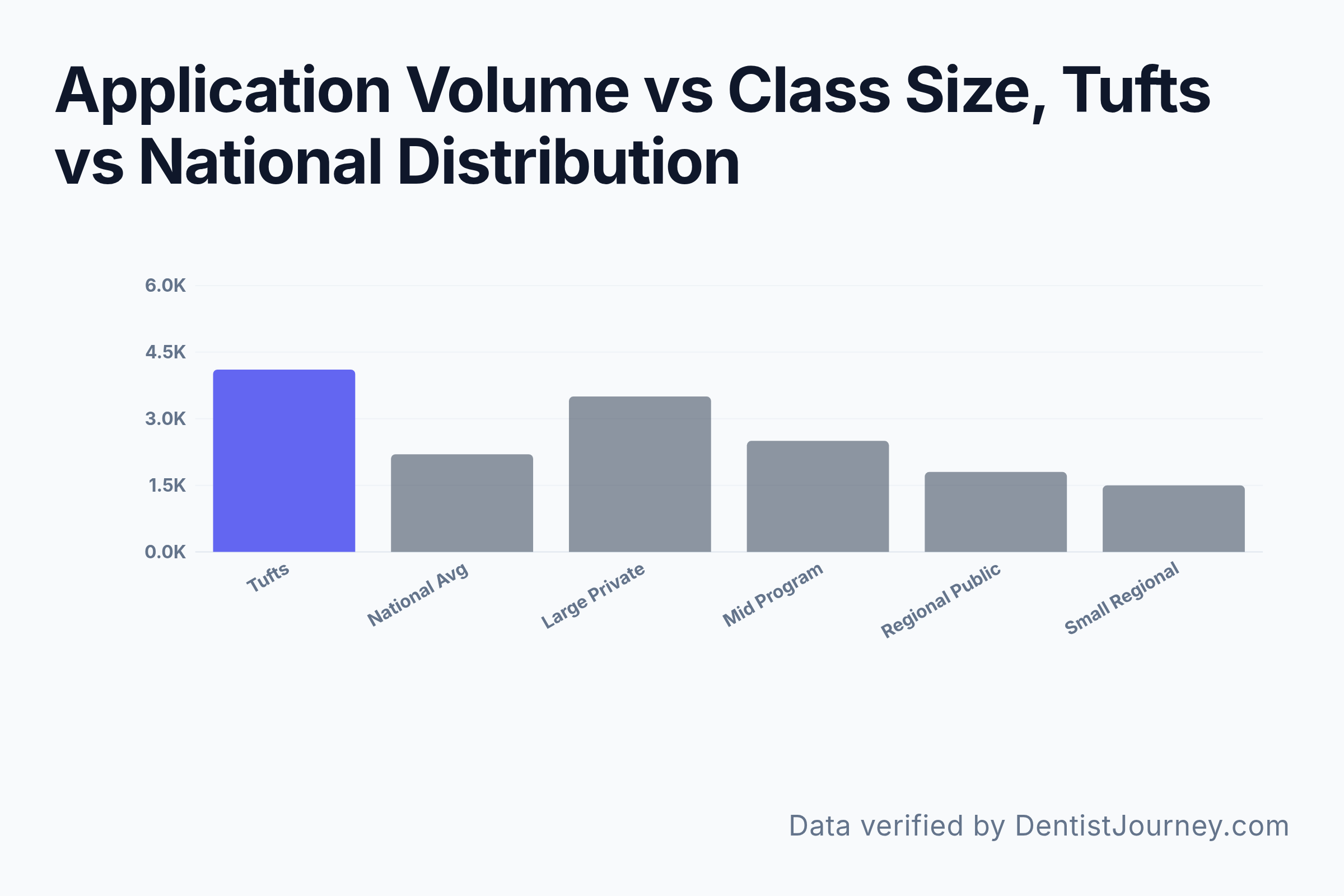
In the latest cycle, Tufts School of Dental Medicine received 4,107 applications, one of the highest raw volumes in the country. For context, the average U.S. dental school class seats 92 students. If Tufts admitted every student it has ever dreamed of admitting, fewer than 5% of those 4,107 applicants would ever see an acceptance letter. That is not a backup plan. That is a coin flip with a $120 application fee glued to it.
And yet Student Doctor Network threads, Reddit, and Discord servers still pass around the same folklore: "Apply to Tufts, you'll get in with a 3.4 and a 19 DAT." The numbers say that advice is dangerous.
The Volume Problem: 4,107 Applications Is Not a Safety Signal
A "safety school" is a program where your stats are well above the median (middle score) and the applicant pool is small. Tufts is neither. Tufts fails both halves of that test.
At 4,107 applications for a class that typically seats around 185 students, the raw application-to-seat ratio is over 22 to 1. Compare that to the programs pre-dents rarely talk about: smaller public and regional programs in the ADEA-reported dataset receive between 1,500 and 2,500 applications, with similar class sizes. Tufts is not taking fewer applications because it is easier. It is taking more applications because its brand, its Boston location, and its relatively open application policy make it the default "one more school" on every applicant's AADSAS list.
That is the trap. The branding that makes Tufts feel accessible is what drives huge application volume. That volume shrinks your real odds.
The Stats Pre-Dents Think They Need (And What Tufts Actually Admits)
Tufts admits applicants at or above the national median of 20.25 DAT and 3.5+ science GPA, not the 3.4 GPA and 19 DAT that pre-dental folklore suggests. The national average DAT score across CODA-accredited U.S. dental schools is 20.34, with a median of 20.25 and a standard deviation of 1.12. Tufts sits squarely inside that distribution, not below it. The national average science GPA hovers at 9.12 at the median.
When a program receives 4,107 applications, admissions committees do not go looking for reasons to say yes to a 3.3 and an 18. They go looking for reasons to say no, because they have to. At that volume, the initial screen is almost mechanical: stats filter, then essays, then interviews. The "safety school" narrative assumes Tufts is desperate. The volume data says the opposite.
A useful mental model: any program getting over 3,500 applications for fewer than 200 seats is operating more like a selective private research university than a regional safety net. The math forces it to.
The Competitor Context: Why Tufts Gets the Volume
Search "Tufts vs BU dental school" on any pre-dental forum and you will find the same pattern. Boston has three dental schools within driving distance: Tufts, Harvard School of Dental Medicine, and Boston University Henry M. Goldman School of Dental Medicine[1]. Harvard admits roughly 35 students per cycle. BU is known for a high-cost, stats-focused admissions process. Tufts, by reputation, is the "apply and see what happens" option of the three.
That reputation is exactly what generates 4,107 applications. Every applicant who thinks "I probably won't get into Harvard, but I'll throw Tufts on the list" contributes to the pile. Multiply that across 10,000+ AADSAS applicants nationally and you get the volume we see.
The result: borderline applicants using Tufts as a safety are competing against thousands of other borderline applicants who made the same bet. The pool at Tufts is not a smaller, weaker version of the Harvard pool. It is a much larger, mostly overlapping version of it.
The Devil's Advocate
Critics might say: "Application volume alone doesn't tell you admission difficulty. Schools can still have generous acceptance rates even with high volumes."
Rebuttal: This is mathematically true in theory and almost never true in practice. With a class size near 185 and application volume at 4,107, the ceiling on acceptance rate is low before you even account for yield protection. Like every private dental school, Tufts admits more students than it seats to hit enrollment targets. But even with a generous 2x yield buffer (370 admits), the acceptance rate lands near 9%. That is not a safety school number. The Ivy League undergraduate admit rate is in the same range.
Critics might also say: "Tufts has historically had higher acceptance rates than its volume suggests."
Rebuttal: "Historically" is doing a lot of work in that sentence. The volume growth in the last 5 cycles has been substantial across most private dental programs. Whatever acceptance rate you remember hearing about from a cousin who applied in 2015 is not the rate you are applying into today.
The Real Cost of Miscategorizing a School
Labeling Tufts a safety often causes applicants to skip 3 to 4 real safeties. Those real safeties are regional public schools that favor in-state applicants. The result: a costlier list with a false floor and more rejection risk. If you label Tufts a safety and skip applying to 3 or 4 actual statistical safeties (regional public programs with lower volumes and in-state preferences), you have not built a safer list. You have built a more expensive, more crowded list with a false floor under it.
The fix is not to avoid Tufts. The fix is to stop calling it a safety and treat it for what the data shows it is: a mid-to-high-selectivity private program that happens to attract enormous volume because of its brand and geography.
Hypothetical scenario: Student A applies to 12 schools including Tufts, BU, NYU, and Penn, labeling Tufts as the "safety." Her actual statistical safeties (2 regional public programs where her stats sit above the median) never make the list. She gets rejected from all four Northeast privates in February. Student B applies to the same 12 schools but swaps Tufts and BU out for 2 regional publics where he has residency or strong fit. Same GPA, same DAT, same essays. Student B has acceptances by December.
The difference is not talent. The difference is list construction.
The Action Plan
To build an accurate AADSAS list, classify a school as a safety only when your stats sit above its median AND application volume is proportional to class size—a test Tufts fails at 4,107 applications for 185 seats. A "safety" is not a school that feels accessible. It is a school where your stats sit above the median AND the applicant volume is proportional to the class size.
That match quiz will run your GPA and DAT against every CODA-accredited program and flag which schools are statistically safeties, targets, and reaches for YOU specifically, not for the mythical "average applicant" that pre-dental folklore keeps referencing.
If you want to browse the raw data yourself, including application volumes, class sizes, and median stats for all 67 programs, the full directory is here:
The takeaway is simple. Tufts is a fine program. Tufts is not a safety. Build your list against the numbers, not the rumor mill.